Hamilton's Pacificus No. 5
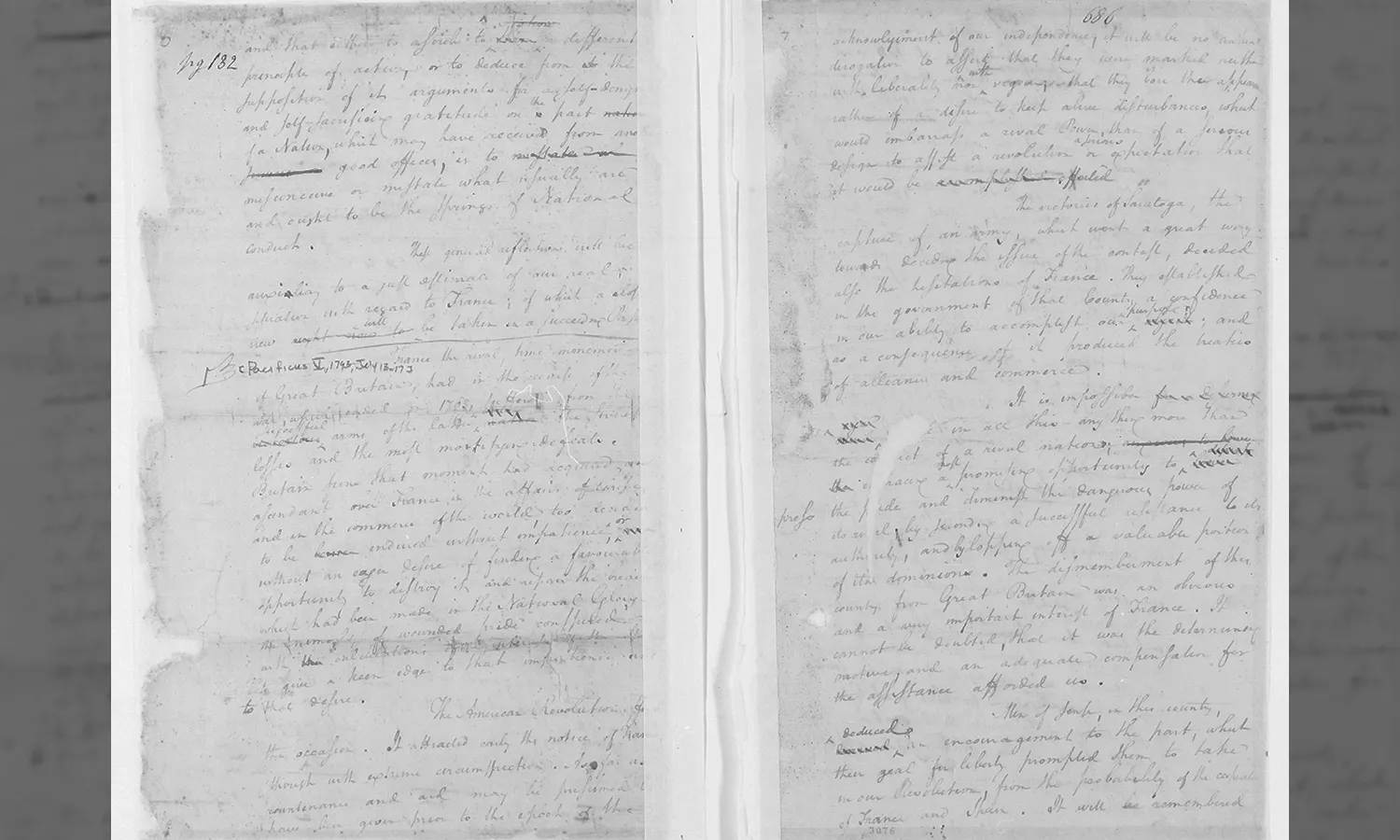
Context: Alexander Hamilton wrote seven newspaper essays defending Washington's Neutrality Proclamation between June 29 and July 27, 1793, under the pseudonym "Pacificus." In this fifth essay, Hamilton explained and defended the proclamation, arguing that neutrality was in America's best interest.
Excerpt:
Men of sense, in this country, deduced an encouragement to the part, which their zeal for liberty prompted them to take in our Revolution, from the probability of the cooperation of France and Spain. It will be remembered that this argument was used in the publications of the day; but upon what was it bottomed? Upon the known competition between those Powers and ⟨Great⟩ Britain, upon their evident interest to reduce her power and circumscribe her empire; not upon motives of regard to our interest or of attac⟨hment⟩ to our cause. W⟨hoever⟩ should have alleged the latter, as grounds of the expectation held out, would have been justly considered as a Visionary, or a Deceiver. And whoever shall now ascribe the aid we received to such motives would not deserve to be viewed in a better light.
The inference from these facts is not obscure. Aid and co[o]peration founded upon a great interest, pursued and obtained by the party affording them, is not a proper stock upon which to en⟨graft⟩ that enthusiastic gratitude, which is claimed fr⟨om us⟩ by those who love France more than the United States.
This view of the subject, extorted by the extravagancy of such a claim, is not meant to disparage the just pretensions of France upon our good will. Though neither in the motives to the succours which she furnished us, nor in their extent (considering how powerfully the point of honor in such a war reinforced the considerations of interest, when she was once engaged) can be found a sufficient basis for that gratitude which is the theme of so much declamation. Yet we shall find in the manner of affording those succours just cause for our esteem and friendship.
France did not attempt, in the first instance, to take advantage of our situation to extort from us any humiliating or injurious concessions, as the price of her assistance; nor afterwards in the progress of the war, to impose hard terms as the condition of particular aids.
Though this course was certainly dictated by policy; yet it was an honorable and a magnanimous policy; such a one as always constitutes a title to the approbation and esteem of mankind and a claim to the friendship and acknowlegement of the party, in whose favour it is practiced.
But these sentiments are satisfied on the part of a Nation; when they produce sincere wishes for the happiness of the party, from whom it has experienced such conduct and a cordial disposition to render all good and friendly offices which can be rendered without prejudice to its own solid and permanent interests.
To ask of a Nation so situated, to make a sacrifice of substantial interest; to expose itself to the jealousy illwill or resentment of the rest of the world; to hazard in an eminent degree its own safety, for the benefit of the party, who may have observed towards it the conduct which has been discribed, would be to ask more than the nature of the case demands, more than the fundamental maxims of Society authorise, more than the dictates of sound reason justify.
For more information about Hamilton's Pacificus essays, or to access the complete "Pacificus No. 5" document, visit Founders Online.