Jefferson's Helvidius No. 1
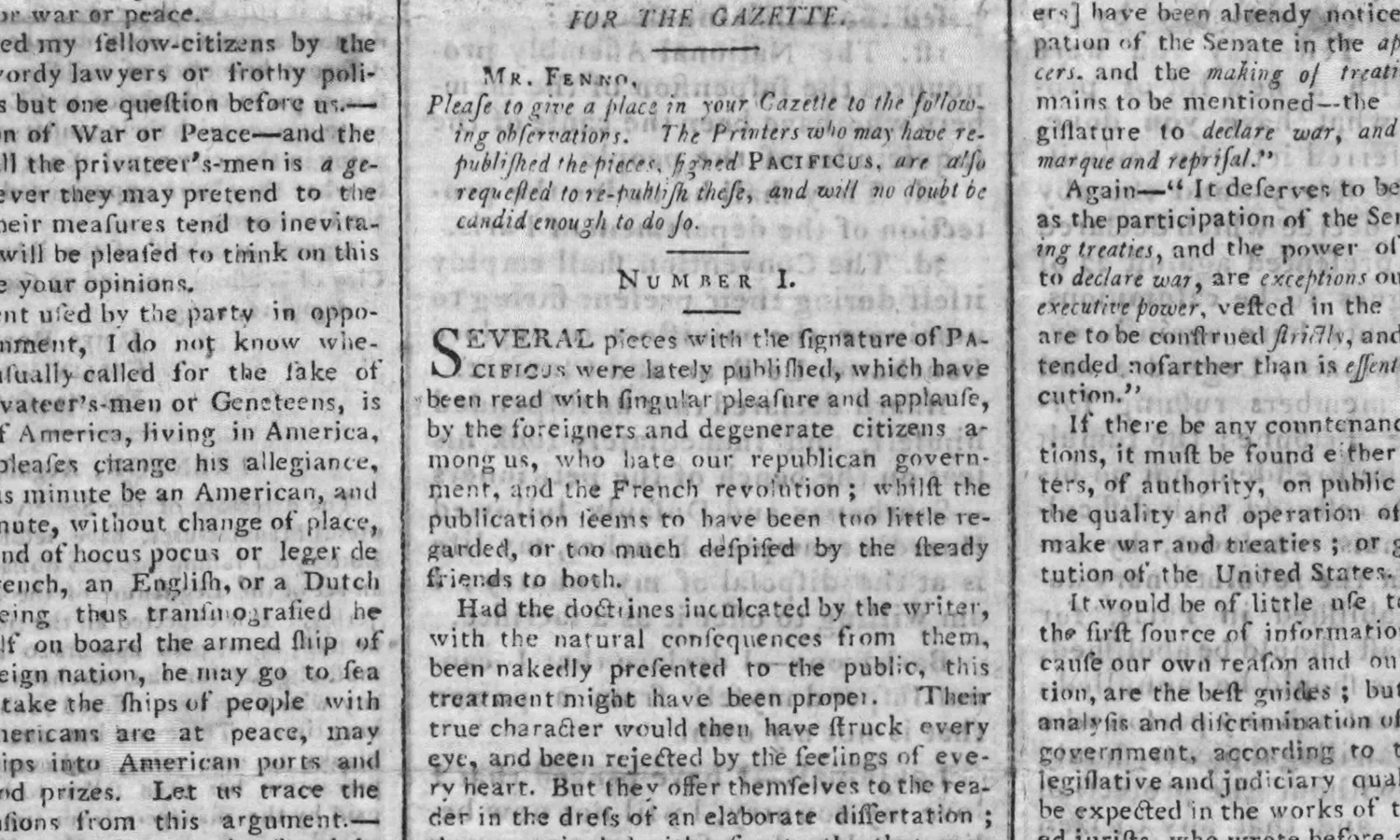
Context: At Thomas Jefferson's urging, James Madison wrote a series of essays under the pseudonym "Helvidius" responding to Hamilton's "Pacificus" essays. In this first essay, Madison argued that the Neutrality Proclamation violated the Constitution by usurping Congress's war-making powers and improperly suspending the 1778 Franco-American treaty.
Excerpt:
Several pieces with the signature of Pacificus were lately published, which have been read with singular pleasure and applause, by the foreigners and degenerate citizens among us, who hate our republican government, and the French revolution; whilst the publication seems to have been too little regarded, or too much despised by the steady friends to both.
Had the doctrines inculcated by the writer, with the natural consequences from them, been nakedly presented to the public, this treatment might have been proper. Their true character would then have struck every eye, and been rejected by the feelings of every heart. But they offer themselves to the reader in the dress of an elaborate dissertation; they are mingled with a few truths that may serve them as a passport to credulity; and they are introduced with professions of anxiety for the preservation of peace, for the welfare of the government, and for the respect due to the present head of the executive, that may prove a snare to patriotism.
…
If we consult for a moment, the nature and operation of the two powers to declare war and make treaties, it will be impossible not to see that they can never fall within a proper definition of executive powers. The natural province of the executive magistrate is to execute laws, as that of the legislature is to make laws. All his acts therefore, properly executive, must pre-suppose the existence of the laws to be executed. A treaty is not an execution of laws: it does not pre-suppose the existence of laws. It is, on the contrary, to have itself the force of a law, and to be carried into execution, like all other laws, by the executive magistrate. To say then that the power of making treaties which are confessedly laws, belongs naturally to the department which is to execute laws, is to say, that the executive department naturally includes a legislative power. In theory, this is an absurdity—in practice a tyranny.
The power to declare war is subject to similar reasoning. A declaration that there shall be war, is not an execution of laws: it does not suppose pre-existing laws to be executed: it is not in any respect, an act merely executive. It is, on the contrary, one of the most deliberative acts that can be performed; and when performed, has the effect of repealing all the laws operating in a state of peace, so far as they are inconsistent with a state of war: and of enacting as a rule for the executive, a new code adapted to the relation between the society and its foreign enemy. In like manner a conclusion of peace annuls all the laws peculiar to a state of war, and revives the general laws incident to a state of peace.
These remarks will be strengthened by adding that treaties, particularly treaties of peace, have sometimes the effect of changing not only the external laws of the society, but operate also on the internal code, which is purely municipal, and to which the legislative authority of the country is of itself competent and compleat.
From this view of the subject it must be evident, that although the executive may be a convenient organ of preliminary communications with foreign governments, on the subjects of treaty or war; and the proper agent for carrying into execution the final determinations of the competent authority; yet it can have no pretensions from the nature of the powers in question compared with the nature of the executive trust, to that essential agency which gives validity to such determinations.
For more information about Jefferson's Helvidius essays, or to access the complete "Helvidius No. 1" document, visit Founders Online.