Boston's Letter to Washington 1795
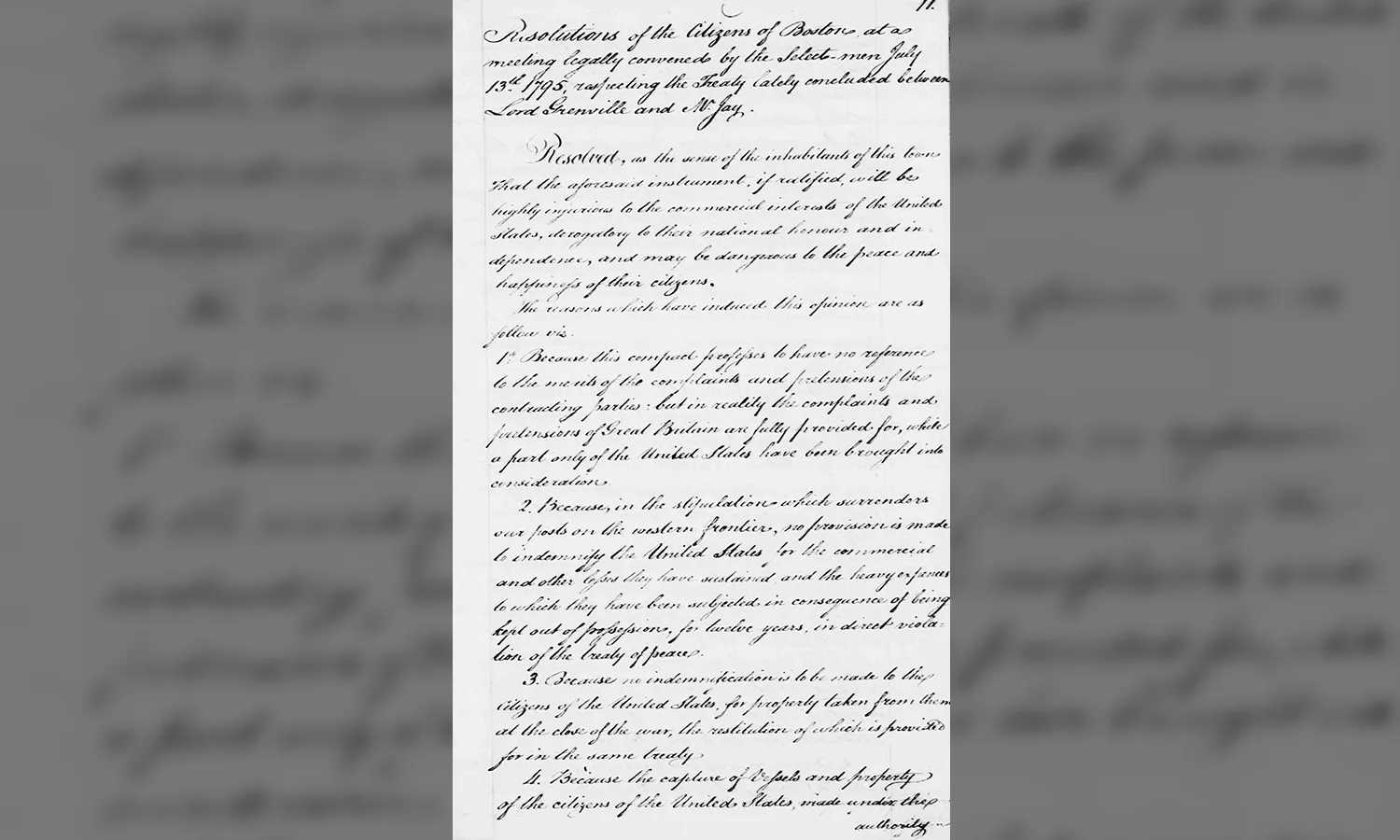
Context: After the Jay Treaty's contents became public, citizens across the United States organized protests against its ratification. Nine Boston selectmen, writing on behalf of Boston's citizens, condemned the treaty in a letter to George Washington.
Excerpt:
At a meeting of the Inhabitants of the Town of Boston, duly & legally warned & convened, by adjournment at Faneuil Hall on Monday the thirteenth day of July, One thousand Seven hundred & ninety five.
A Pamphlet printed at Philadelphia under the signature of Stevens Thomson Mason, one of the Senators of the United States from the Commonwealth of Virginia, & purporting to be a genuine Copy of a Treaty of Amity, Commerce, & Navigation, entered into at London on the nineteenth day of November last between Lord Grenville, on the part of his Britanick Majesty, and John Jay Esquire, on the part of the United States, was read, and duly considered, and thereupon it was,
Resolved, as the sense of the Inhabitants of this Town, that the aforesaid Instrument, if ratified, will be highly injurious to the commercial Interest of the United States, derogatory to their National honor, and Independence, and may be dangerous to the Peace and happiness of their Citizens.
The reasons which have induced this opinion are as follow, vizt
1st Because this Compact professes to have no reference to the merits of the complaints, & pretensions of the contracting parties; but in reality the complaints & pretensions of Great Britain, are fully provided for, while a part only, of those of the United States, have been brought into consideration.
…
4th Because the capture of Vessells, & property of Citizens of the United States, during the present war, made under the authority of the Government of Great Britain, is a National Concern, and claims arising from such captures, ought not to have been submitted to the decision of their Admiralty Courts, as the United States are thereby precluded from having a voice in the final determination of such cases; because the indemnification proposed, is to be sought by a process tedious & expensive, in which justice may be delayed to an unreasonable time, & eventually lost to many of the sufferers from their inability to pursue it; and because this mode of Indemnification bears no proportion to the summary method adopted for the satisfaction of British Claims.
…
12th Because it concedes a right to the British Government to search & detain our vessells in time of war, between them, & other Nations, under frivolous, & vexatious pretexts.
…
14th Because it surrenders all, or most of the benefits of a commercial nature, which we had a right to expect, from our Neutrality in the present European War.
…
17th Because it permits the British Nation to convert provisions, destined to other Nations at war with them, to their own use, on payment of what they may deem a reasonable profit; a measure not only injurious to the Interests of the American Merchant, but which will prevent our citizens from carrying American productions to other Countries, which by the Laws of Nature, and Nations they have a right to do without molestation.
…
19th Because it exposes the United States, and their Commerce to similar embarrassments from other commercial Nations, all of whom will probably regulate our trade, by this partial standard.
For more information about Boston's Letter to Washington, or to access the complete document, visit Founders Online.