Fukuyama's “The End of History?,” 1989
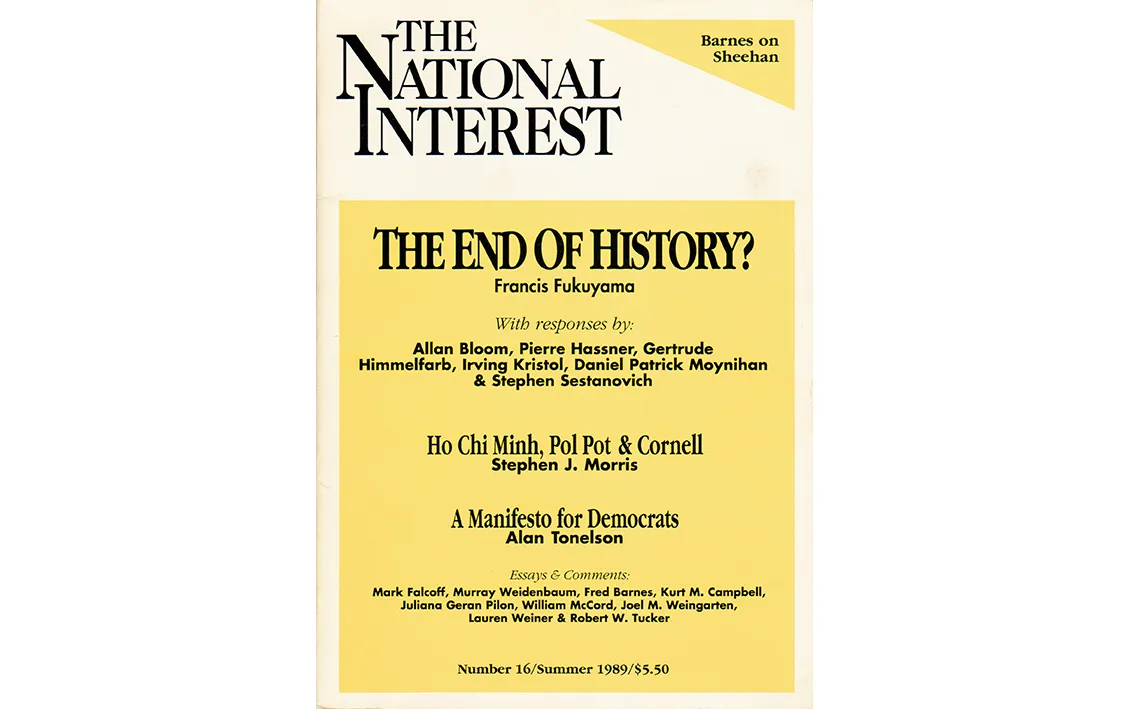
Context: After the Berlin Wall fell, political scientist Francis Fukuyama published an essay in the National Interest that became one of the most influential assessments of the post–Cold War moment. Fukuyama argued that the collapse of communism marked not merely the end of an era but also the triumph of Western liberal democracy. The essay’s assumptions shaped how U.S. policymakers approached engagement with former adversaries, including China, throughout the 1990s.
Excerpt:
In watching the flow of events over the past decade or so, it is hard to avoid the feeling that something very fundamental has happened in world history. The past year has seen a flood of articles commemorating the end of the Cold War, and the fact that "peace" seems to be breaking out in many regions of the world. Most of these analyses lack any larger conceptual framework for distinguishing between what is essential and what is contingent or accidental in world history, and are predictably superficial.
[...]
And yet, all of these people sense dimly that there is some larger process at work, a process that gives coherence and order to the daily headlines. The twentieth century saw the developed world descend into a paroxysm of ideological violence, as liberalism contended first with the remnants of absolutism, then bolshevism and fascism, and finally an updated Marxism that threatened to lead to the ultimate apocalypse of nuclear war. But the century that began full of self-confidence in the ultimate triumph of Western liberal democracy seems at its close to be returning full circle to where it started: not to an "end of ideology" or a convergence between capitalism and socialism, as earlier predicted, but to an unabashed victory of economic and political liberalism.
The triumph of the West, of the Western idea, is evident first of all in the total exhaustion of viable systematic alternatives to Western liberalism. In the past decade, there have been unmistakable changes in the intellectual climate of the world's two largest communist countries, and the beginnings of significant reform movements in both. But this phenomenon extends beyond high politics and it can be seen also in the ineluctable spread of consumerist Western culture in such diverse contexts as the peasants' markets and color television sets now omnipresent throughout China, the cooperative restaurants and clothing stores opened in the past year in Moscow, the Beethoven piped into Japanese department stores, and the rock music enjoyed alike in Prague, Rangoon, and Tehran.
What we may be witnessing is not just the end of the Cold War, or the passing of a particular period of postwar history, but the end of history as such: that is, the end point of mankind's ideological evolution and the universalization of Western liberal democracy as the final form of human government. This is not to say that there will no longer be events to fill the pages of Foreign Affair's yearly summaries of international relations, for the victory of liberalism has occurred primarily in the realm of ideas or consciousness and is as yet incomplete in the real or material world. But there are powerful reasons for believing that it is the ideal that will govern the material world in the long run.
[...]
The passing of Marxism-Leninism first from China and then from the Soviet Union will mean its death as a living ideology of world historical significance. [...] And the death of this ideology means the growing "Common Marketization" of international relations, and the diminution of the likelihood of large-scale conflict between states.
This does not by any means imply the end of international conflict per se. [...] Terrorism and wars of national liberation will continue to be an important item on the international agenda. But large-scale conflict must involve large states still caught in the grip of history, and they are what appear to be passing from the scene.
The end of history will be a very sad time. The struggle for recognition, the willingness to risk one's life for a purely abstract goal, the worldwide ideological struggle that called forth daring, courage, imagination, and idealism, will be replaced by economic calculation, the endless solving of technical problems, environmental concerns, and the satisfaction of sophisticated consumer demands. [...] Perhaps this very prospect of centuries of boredom at the end of history will serve to get history started once again.
For the full version of Francis Fukuyama's 1989 essay "The End of History?" click here.