Amnesty International on Human Rights Violations in China, 1996
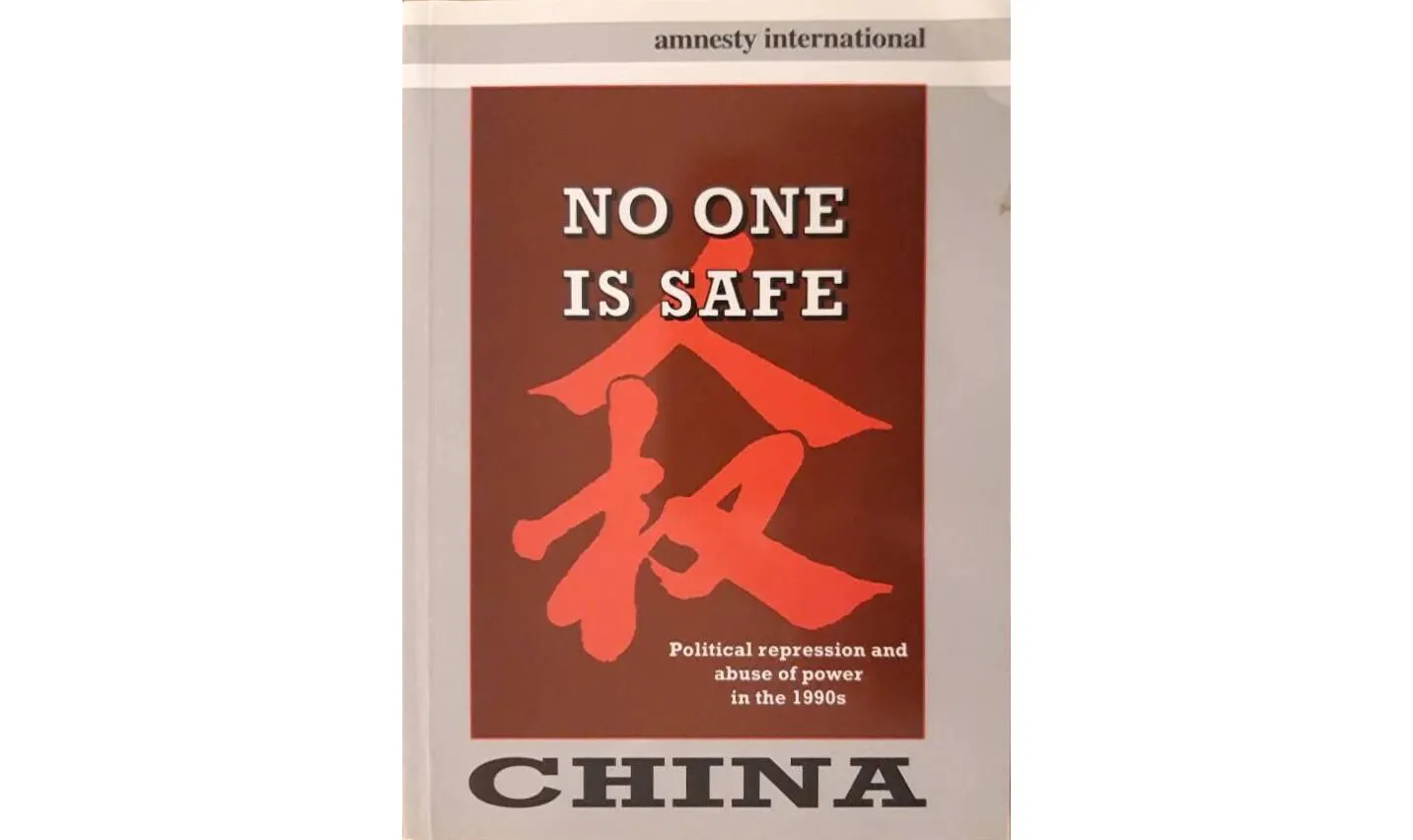
Context: In 1996, the human rights group Amnesty International published a report on ongoing political repression and human rights violations in China, titled “China: No One Is Safe — Political Repression and Abuse of Power in the 1990s.” The excerpts below document cases of political imprisonment, torture, and execution in China. Critics of trade with China cited violations like these to argue against engagement without conditions. Supporters argued that engagement would, over time, improve conditions on the ground.
Excerpts:
Gao Yu, journalist:
In November 1994 Gao Yu, a well-known journalist in China, was convicted of "leaking important state secrets" in articles she had written for two Hong Kong magazines. She was sentenced after a secret trial to six years in prison and a further year's deprivation of political rights. Her husband and lawyers were not informed of the trial. The verdict indicated that the "state secrets" in question concerned political and not national security issues. Moreover, all the evidence suggests that the court had condemned Gao Yu before her trial.
Prior to the announcement of the verdict, Gao Yu was brought to trial three times in 1994. Each time the court found that the evidence against her "still needed to be verified" meaning that the prosecution evidence was insufficient to convict her. On three occasions the court returned her case to the Beijing procuracy "for supplementary investigation and verification". Throughout these proceedings, the court ignored the information and arguments presented by the defence, which challenged the validity of the evidence against Gao Yu.8 Amnesty International believes that Gao Yu is a prisoner of conscience jailed solely for the peaceful exercise of her right to freedom of expression.
Ren Wanding, human rights defender:
"I am no longer afraid. I have already died once in prison. Once you have been there, you are never really afraid again."
These words were spoken by Ren Wanding a few weeks before he was jailed in June 1989. He is one of many people who have bravely stood up for human rights in China, despite the personal risks. A variety of groups and activities have been organized in recent years attempting to promote and protect human rights; all have been repressed by the government, often using means that flout or abuse Chinese law. Despite the intimidation, new human rights initiatives by individuals and organizations are still being reported on a regular basis.
Ren Wanding, a 49-year-old former accountant, was arrested shortly after the 1989 crackdown and sentenced on 26 January 1991 to seven years' imprisonment on charges of "carrying out counter-revolutionary propaganda and incitement". This was based on views he had expressed in speeches and essays during the 1989 pro-democracy movement, in which he called for respect for human rights, free speech and the rule of law. Ren Wanding had been the co-founder of the Chinese Human Rights Alliance, a small group formed in Beijing in late 1978. The group ceased to exist a few months later after its members were arrested. Ren Wanding was detained on 4 April 1979 as he was pasting up a poster on the "democracy wall" and subsequently spent four years in prison. After his release he continued to write and distribute essays on human rights issues.
Since Ren Wanding's most recent arrest, his health has deteriorated considerably. His wife, Zhang Fengying, has appealed to the authorities to improve his conditions of imprisonment and to release him on medical parole. He remains in Beijing Prison No.2.
Yan Zhengxue, painter and local People’s Congress deputy (in his own words):
"When we arrived at the police station, the tall thin one boxed my ears five or six times, then hit me with his electric truncheon, forcing me to the floor. Then they put handcuffs on me... After several blows to my head and face I saw stars and fell to the floor. They pulled me to my feet by my hair and continued the beating. I reckon he hit me with about 30 blows. Another fat policeman kicked my legs, an older man stood by, watching. By now, I was nauseous and wanting to vomit...At last I collapsed on the floor and could not struggle. Then another policeman came over and kicked me in the groin... They went on kicking my stomach and groin. My groin was unbearably painful and I tried to protect it with my hands. They pulled me by the hair and forced me to squat. By now my hands had lost almost all feeling..."
This is the testimony of Yan Zhengxue, a 50-year-old painter and deputy of a local People's Congress in Zhejiang province. He was detained after police had been called following an argument with a bus conductor in Beijing on 2 July 1993. Even though he was not suspected of a crime, he was taken to the Haidian district police station where the police beat him without a word of explanation. Eventually, late at night, Yan Zhengxue was pushed out of the police station, almost unconscious. A passer-by took him to the Xiyuan hospital, which recorded multiple bruising and abrasions to his back, head, hands, shoulders and groin. Yan Zhengxue filed a suit against his attackers, but, in retribution, the police framed him on a misdemeanour and he was sent to a labour camp.
Click here to access the full report from Amnesty International.