Louis Armstrong's Jazz Diplomacy
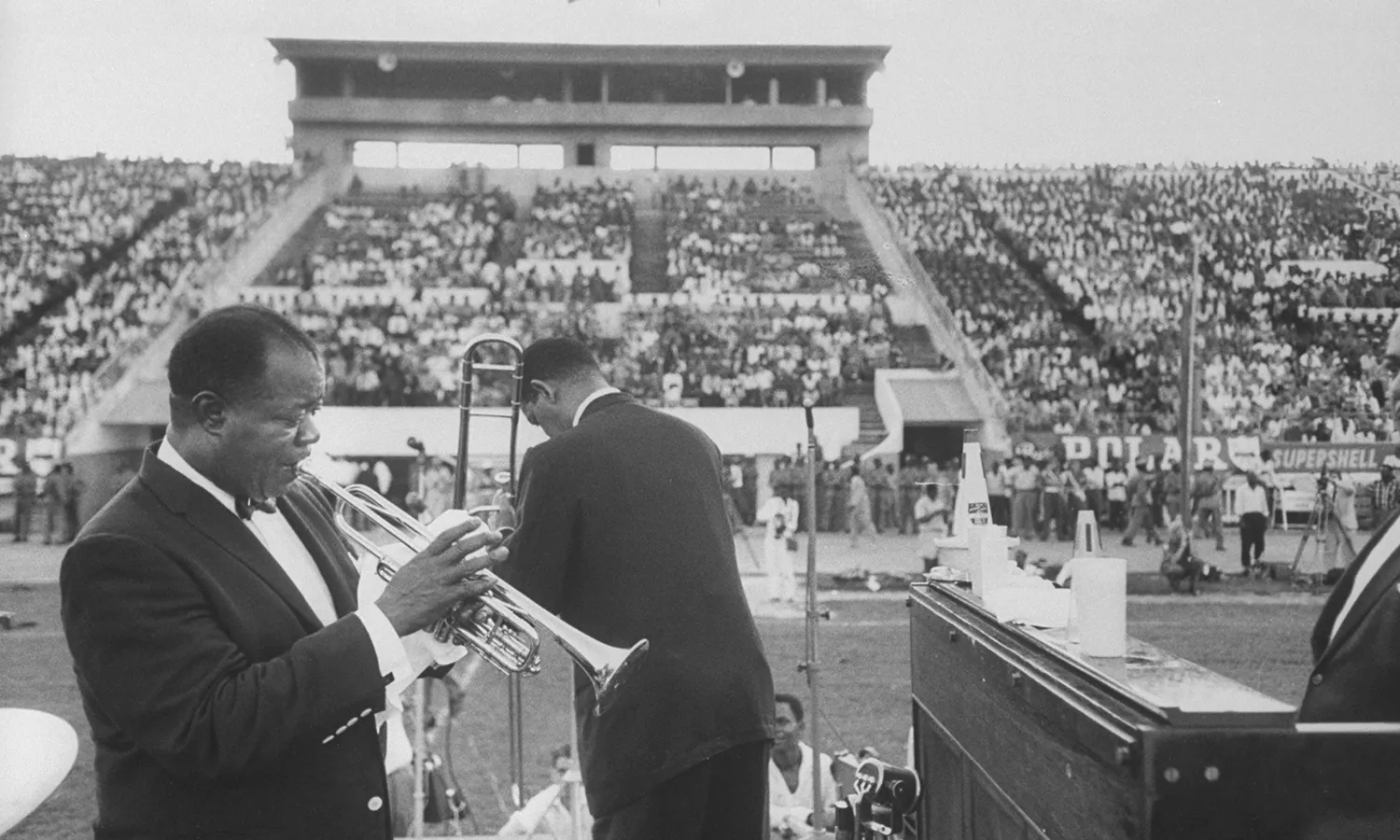
Context: In 1956, the State Department began sending jazz musicians around the world to improve America’s public image—part of a wider Cold War culture strategy. In October 1960, Louis Armstrong traveled to the Republic of the Congo, which had recently experienced a military coup amid significant U.S. interference in Congolese politics. A State Department memo describes the trip and its impact on U.S. perceptions in the country.
Excerpt:
Foreign Service Despatch
From: Amembassy Leopoldville
To: The Department of State, Washington Date: November 17, 1960
Subject: Cultural Presentations: President's Program--Visit of Louis Armstrong
Summary: Presentation of Louis Armstrong to trouble-torn Leopoldville was a happy success from strict PR standpoint. Government, press and mass were delighted to have him and cooperated wholeheartedly to give him a city-wide reception. Though Congolese don't yet dig the on-beat music of Satchmo, they like him and the idea of his coming.
Louis "Satchmo" Armstrong brought the first happy event to this trouble-torn city since independence on June 30. We have wide evidence that the Congolese appreciated this friendly gesture by the U.S. and that the impact of his visit will leave a sweet taste in Leopoldville for a long time to come.
Here's how it happened: Louis and party arrived by special boat (we sent for him) from Brazzaville on the morning of October 28. A crowd of two or three thousand gathered to greet him at the dock in Leo. The GOC's Commissaire of Information, Mr. Albert Bolela, was on hand too. He had cooperated with the Embassy to give Satchmo an official welcome. Young girls in blue of the Institut Musicale presented Mrs. Armstrong with flowers as she stepped ashore.
Then a motorcade wound through the city and native market to the Parc de Bock, led by a truck full of tom-toms and dancers inextricably mixed in action throughout the journey of one mile.
At the Parc de Bock several hundred official guests were on hand to watch with Louis a varied and charming musical greeting master-minded by the GOC's Director of Cultural Affairs, Mr. Albert Mongita; but disciplined down to a smoothly paced one-half hour by the Embassy to conserve Satchmo's strength. There were dancers and songs created specially for Satchmo (see words attached) and a speech by Bolela.
After a lunch with journalists, cultural leaders and GOC information officials, the stadium performance was held with 10,000 in attendance. The Catholic father, Pere Bollen who manages the stadium, told us we would be lucky to draw 1500 considering the adverse circumstances:
- Having to hold it during office hours on a working day.
- The dangerous security situation in the city which would frighten people into staying home.
- All the military on hand to protect Satchmo would scare citizens who are often mistreated by soldiers and/or police.
(An additional hurdle arose when the start was delayed one-half hour because the local "CUITRAMA" dancers weren't ready. This resulted in Satchmo having to play part of his repertoire after dark; and nightfall caused an immediate and steady exit of Congolese, so much so Louis had to cut his show short by at least 30 minutes.)
The first hour of the program at the stadium was staged by "CUITRAMA", a parastatal cultural organization. Their show consisted of native dancers and singers which, though colorful, were not terribly popular. Their best gimmick was how they brought Armstrong into the stadium. Several of the dancers met Satchmo at the entrance and carried "Le Roi de Jazz" in on a chair mounted upon poles; this is an honor generally reserved for important tribal kings.
[…]
Although we were pressured by some to have special seats at high prices for music-loving ex-colons and other whites, we resisted. Seats were all a uniform price and far more Congolese were invited to the honor tribune than non-Congolese. We wanted it perfectly clear that Satchmo was visiting the Congo as a gesture to the Congolese.
Armstrong personally met scores of very important Congolese at the official welcome, the lunch we gave for him, at the performance itself, and at the Ambassador's reception and the private dinner after the reception. He was uniformly popular with all.
Security was a prime problem. To guard against any extremist group that might exploit Armstrong's visit by staging violence, we spent endless hours and days contacting top Congolese officials to take the proper security cautions. We saw Commissaires' President Bomboko twice, Colonel Mobutu for one hour and Kulamba (Provincial Minister of Interior--in charge of police) twice, and also called on the U.N. military. The results were almost too excellent--Armstrong was protected so constantly by the police, at times he appeared to be in a police state. The ANC was in evidence to back up the police, and the UN to back up the ANC!
For more information about Louis Armstrong's jazz diplomacy, or to access the complete State Department memo, visit Louis Armstrong House.