Stalin's Election Speech, 1946
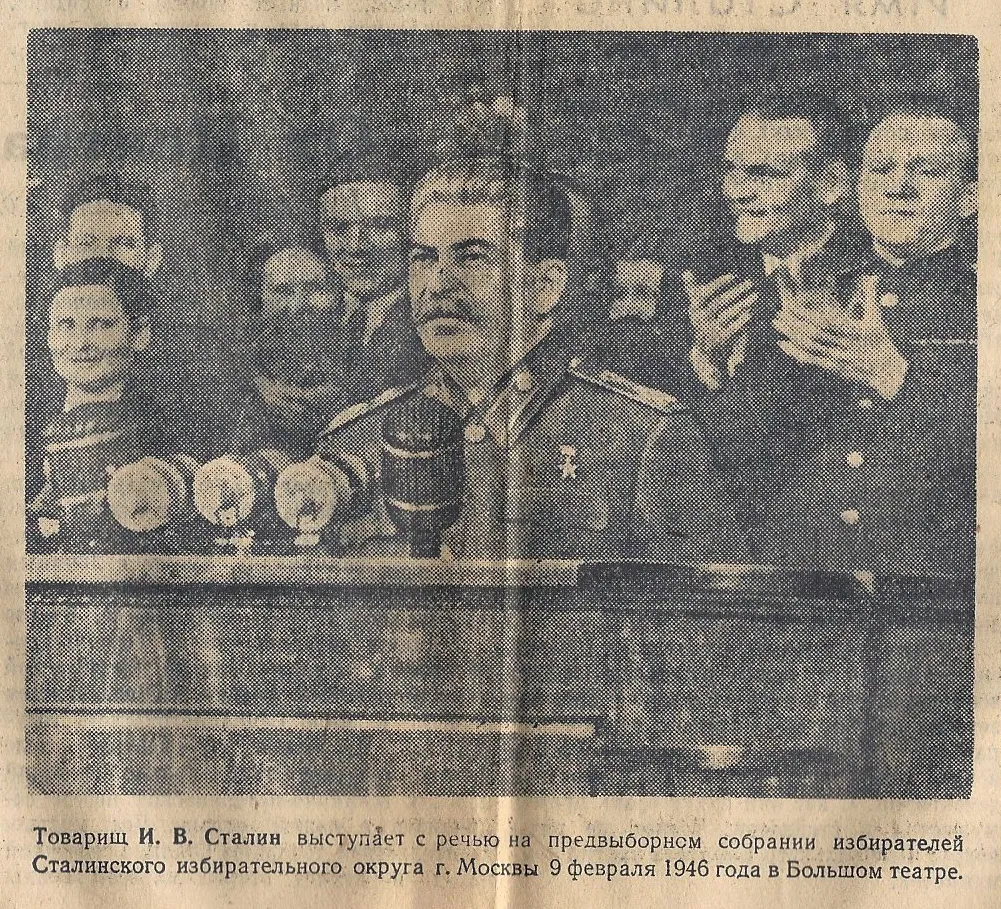
Context: Shortly after World War II, Soviet Premier Joseph Stalin gave a fiery speech to an audience of political leaders and constituents. He blamed capitalism for causing global instability. He then praised the Soviet model and called for increased industrial production—rhetoric that quickly alarmed U.S. officials.
Excerpt:
It would be wrong to think that the Second World War broke out accidentally, or as a result of blunders committed by certain statesmen, although blunders were certainly committed. As a matter of fact, the war broke out as the inevitable result of the development of world economic and political forces on the basis of present-day monopolistic capitalism. Marxists have more than once stated that the capitalist system of world economy contains the elements of a general crisis and military conflicts, that, in view of that, the development of world capitalism in our times does not proceed smoothly and evenly, but through crises and catastrophic wars. The point is that the uneven development of capitalist countries usually leads, in the course of time, to a sharp disturbance of the equilibrium within the world system of capitalism, and that group of capitalist countries regards itself as being less securely provided with raw materials and markets usually attempts to change the situation and to redistribute "spheres of influence" in its own favor—by employing armed force. As a result of this, the capitalist world is split into two hostile camps, and war breaks out between them.
[…]
The issue now is not whether the Soviet social system is viable or not, because after the object lessons of the war, no skeptic now dares to express doubt concerning the viability of the Soviet social system. Now the issue is that the Soviet social system has proved to be more viable and stable than the non-Soviet social system, that the Soviet social system is a better form of organization of society than any non-Soviet social system.
Secondly, our victory [in the Second World War] signifies that our Soviet state system was victorious, that our multinational Soviet state passed all the tests of the war and proved its viability.
[…]
It would be wrong to think that such a historical victory could have been achieved without preliminary preparation by the whole country for active defense. [...] But for this it was necessary to have, and in, sufficient quantities, elementary things such as: metals—for the production of armaments, equipment and industrial machinery; fuel—to ensure the operation of industry and transport; cotton—to manufacture army clothing; grain—to supply the army with food.
[…]
As regards long-term plans, our Party intends to organize another powerful upswing of our national economy that will enable us to raise our industry to a level, say, three times as high as that of prewar industry. We must see to it that our industry shall be able to produce annually up to 50,000,000 tons of pig iron, up to 60,000,000 tons of steel, up to 500,000,000 tons of coal and up to 60,000,000 tons of oil. Only when we succeed in doing that can we be sure that our Motherland will be insured against all contingencies. This will need, perhaps, another three five-year plans, if, not more. But it can be done, and we must do it.
For more information about Joseph Stalin's election speech or to access the complete speech, visit Michigan State University.