Walter Lippmann, The Cold War, A Study in U.S. Foreign Policy, 1947
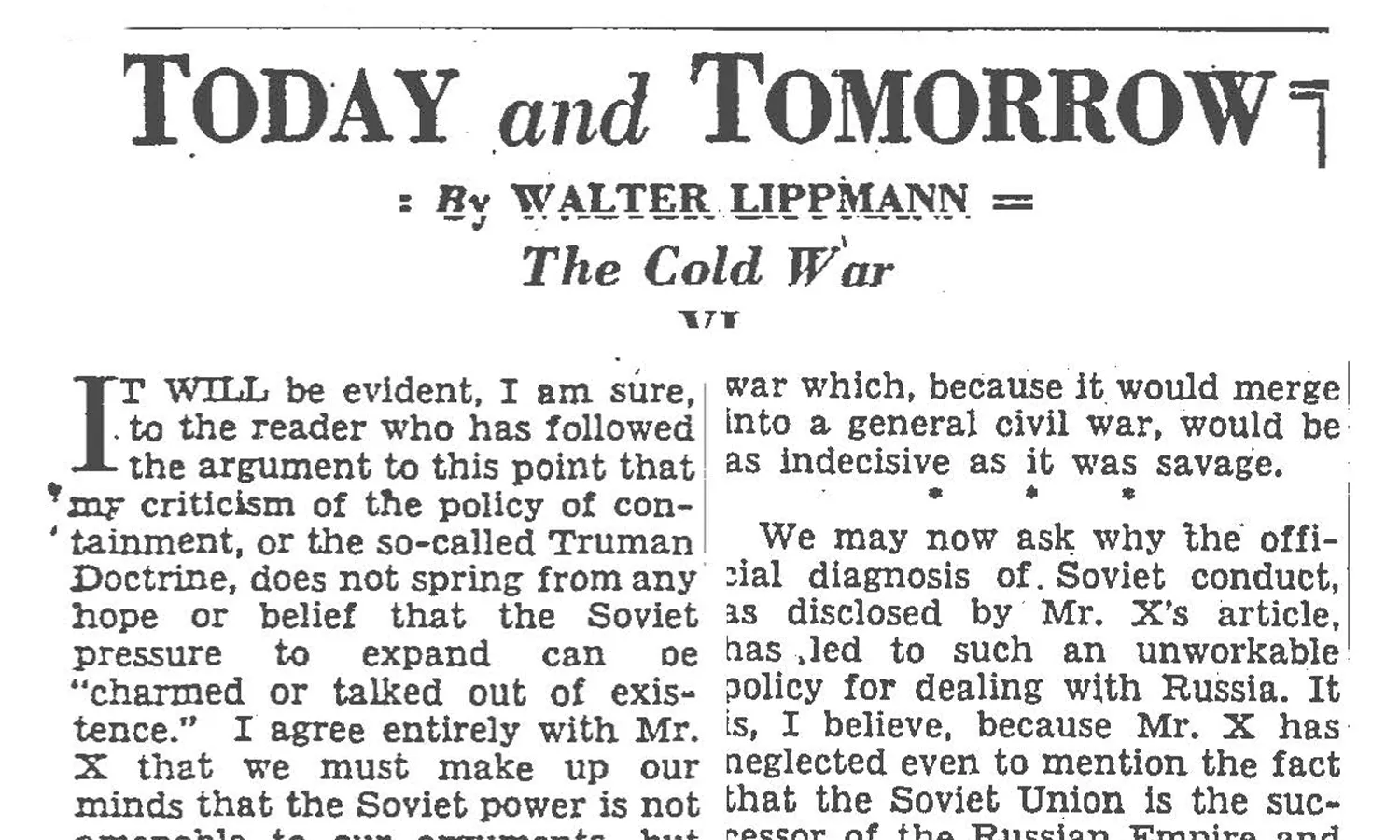
Context: Not everyone agreed with the U.S. containment strategy. In a series of columns published in 1947, journalist Walter Lippmann, who helped popularize the term “cold war,” questioned containment’s logic. He argued that containment alienated U.S. allies and that only if U.S. and Soviet armies left Europe could there be a more stable balance of power.
Excerpt:
My objection […] to the policy of containment is not that it seeks to confront the Soviet power with American power, but that the policy is misconceived, and must result in a misuse of American power. For as I have sought to show, it commits this country to a struggle which has for its objective nothing more substantial than the hope that in ten or fifteen years the Soviet power will, as the result of long frustration, “break up” or “mellow.” In this prolonged struggle the role of the United States is, according to [George Kennan], to react “at a series of constantly shifting geographical and political points” to the encroachments of the Soviet power.
The policy, therefore, concedes to the Kremlin the strategical initiative as to when, where and under what local circumstances the issue is to be joined. It compels the United States to meet the Soviet pressure at these shifting geographical and political points by using satellite states, puppet governments and agents which have been subsidized and supported, though their effectiveness is meager and their reliability uncertain. By forcing us to expend our energies and our substance upon these dubious and unnatural allies on the perimeter of the Soviet Union, the effect of the policy is to neglect our natural allies in the Atlantic community, and to alienate them.
They are alienated also by the fact that they do not wish to become, like the nations of the perimeter, the clients of the United States in whose affairs we intervene, asking as the price of our support that they take the directives of their own policy from Washington. They are alienated above all by the prospect of war, which could break out by design or accident, by miscalculation or provocation, if at any of these constantly shifting geographical and political points the Russians or Americans became so deeply engaged that no retreat or compromise was possible.
[…]
I am contending that the American diplomatic effort should be concentrated on the problem created by the armistice—which is on how the continent of Europe can be evacuated by the three non-European armies which are now inside Europe. This is the problem which will have to be solved if the independence of the European nations is to be restored. Without that there is no possibility of a tolerable peace. But if these armies withdraw, there will be a very different balance of power in the world than there is today, and one which cannot easily be upset. For the nations of Europe, separately and in groups, perhaps even in unity, will then, and then only, cease to be the stakes and the pawns of the Russian-American conflict.
[…]
For if, and only if, we can bring about the withdrawal of the Red Army from the Yalta line to the new frontier of the Soviet Union—and simultaneously, of course, the withdrawal of the British and American armies from continental Europe—can a balance of power be established which can then be maintained. For after the withdrawal, an attempt to return would be an invasion—an open, unmistakable act of military aggression. Against such an aggression, the power of the United States to strike the vital centers of Russia by air and by amphibious assault would stand as the opposing and deterrent force. And until treaties are agreed to which bring about the withdrawal of the Red Army, the power of the United States to strike these vital centers would be built up for the express purpose of giving weight to our policy of ending the military occupation of Europe.
All the other pressures of the Soviet Union at the “constantly shifting geographical and political points,” which [George Kennan] is so concerned about—in the Middle East and in Asia—are, I contend, secondary and subsidiary to the fact that its armed forces are in the heart of Europe. It is to the Red Army in Europe, therefore, and not to ideologies, elections, forms of government, to socialism, to communism, to free enterprise, that a correctly conceived and soundly planned policy should be directed.
For more information about Walter Lippmann's column, "The Cold War: A Study in U.S. Foreign Policy", or to access the full document, visit Teaching American History.