What Is Global Health?
We have made advances in global health, but we face challenges from new disease trends—and need funding to treat them.
Over the last century, great progress has been made in the field of global health. The world is, on balance, much healthier. Global life expectancy is rising and infectious disease rates are declining.
However, as the world becomes healthier, new challenges are emerging. The gains made in global health are not evenly distributed around the world, and in many places, people are still dying of preventable illnesses. As the world becomes more interconnected, infectious diseases spread faster from one country to another. And as life expectancy has increased, noncommunicable diseases (NCDs)—such as cancer, diabetes, and dementia—have become the leading cause of death and disability globally.
In addition to the challenges of emerging disease trends, the lack of international funding and cooperation to treat and prevent diseases persists. Global health funding comes from a crowded field of UN agencies, international organizations, governments, and private donors. Although the Trump administration significantly scaled back U.S. global health funding in 2025, the U.S. government has historically supplied the greatest amount by far—nearly 30 percent in some years. In the private sector, the Gates Foundation is the biggest global health funder, contributing $4 billion in 2025. The future of global health advancements depends significantly on those two donors and their interests.
Transcript: The 3 Main Challenges of Global Health Today
The world is far healthier than ever before. Global life expectancy is increasing in most countries, and diseases like AIDS, tuberculosis, and malaria are on the decline.
Despite decades of progress, plenty of work remains. Every year, more than six million children die before their fifth birthday, the majority by preventable causes. Rates of asthma are increasing among the young and the old. And a virus like H1N1 can spread from San Diego to Shanghai in only a matter of days.
Those who are tasked with improving global health face three major challenges:
- noncommunicable diseases, or NCDs;
- infectious diseases; and
- funding for treatment and prevention.
Noncommunicable diseases like cancer and diabetes are the world’s biggest killers.
In 1990, three of the top seven global causes of death were NCDs. In 2015, it was six out of seven. This is in part because global life expectancy and standards of living are on the rise.
As countries get richer, and their populations get older, people are increasingly exposed to the risk factors of NCDs, such as a sedentary lifestyle, increased substance abuse, and access to processed foods.
In Africa, cancer now kills about 450,000 people annually. But by 2030, that rate is projected to climb to almost one million people each year.
Noncommunicable diseases often require extensive, long-term care, and access to affordable treatment can be a major obstacle in both developing and developed countries.
Unlike NCDs, the rates of infectious diseases are down worldwide. However, they still present a major global health challenge because outbreaks are difficult to predict and just as hard to prepare for.
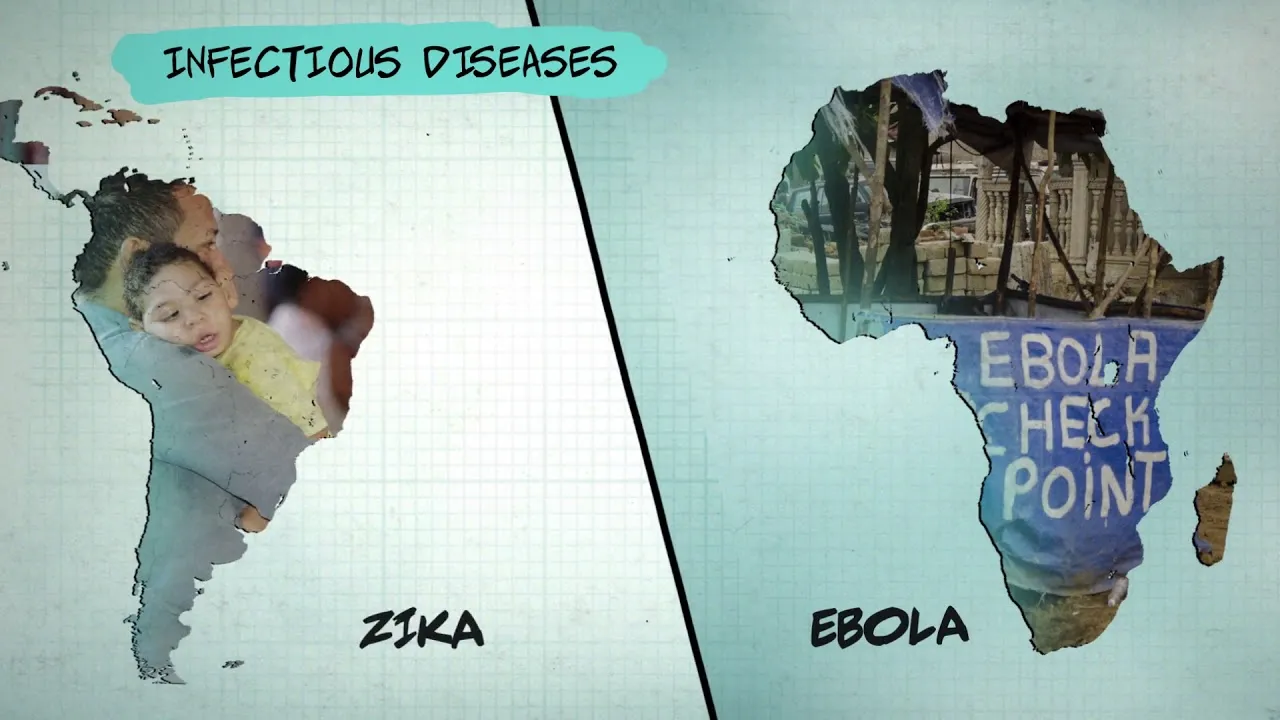
The 2013 Ebola epidemic killed thousands in West Africa. More recently, Zika has been linked to birth defects in children throughout Latin America and the Caribbean, and it has scared off tourists from the worst-hit countries, costing local economies billions of dollars.
Health officials can only do so much to respond to infectious diseases. Because viruses spread undetected and mutate rapidly, it becomes a race to protect the healthy and quarantine the sick.
In the face of an outbreak, international coordination can reduce the odds of a disease spreading to other countries. But with a crowded cast of forty government-to-government donors, twenty-five UN agencies, twenty global and regional funds, and ninety global initiatives involved in any serious outbreak, coordination is a challenge. It can be difficult to even determine who’s in charge.
The World Health Organization could be taking a leading role. It was established after World War II for that specific purpose, but today its capabilities and resources are no match for the proliferation of global health problems.
Instead, the majority of funding for these organizations comes straight from the so-called Two Washingtons—the Gates Foundation, which gives 68 percent of private donations in the realm of health, and the U.S. government, which provides 52 percent of all public funding for global health.
While crucial to maintaining health programs around the world, especially in low-income countries dependent on foreign aid, the concentrations of funding for these two sources makes the whole system extremely vulnerable to personal and political developments.
In 2000, 189 countries made a historic commitment to improving the lives of the world’s poorest citizens, which became eight specific Millennium Development Goals. Three of these were health related.
In 2015, the UN replaced these objectives with seventeen Sustainable Development Goals, eleven of which deal with improving global health outcomes.
Finding new ways to effectively respond to noncommunicable and infectious diseases, and overcoming funding challenges, will help achieve these goals, which are more important than ever before—because in an increasingly connected world, health in one country affects health in all.
Learn More


