FDR's "I Hate War" Speech 1936
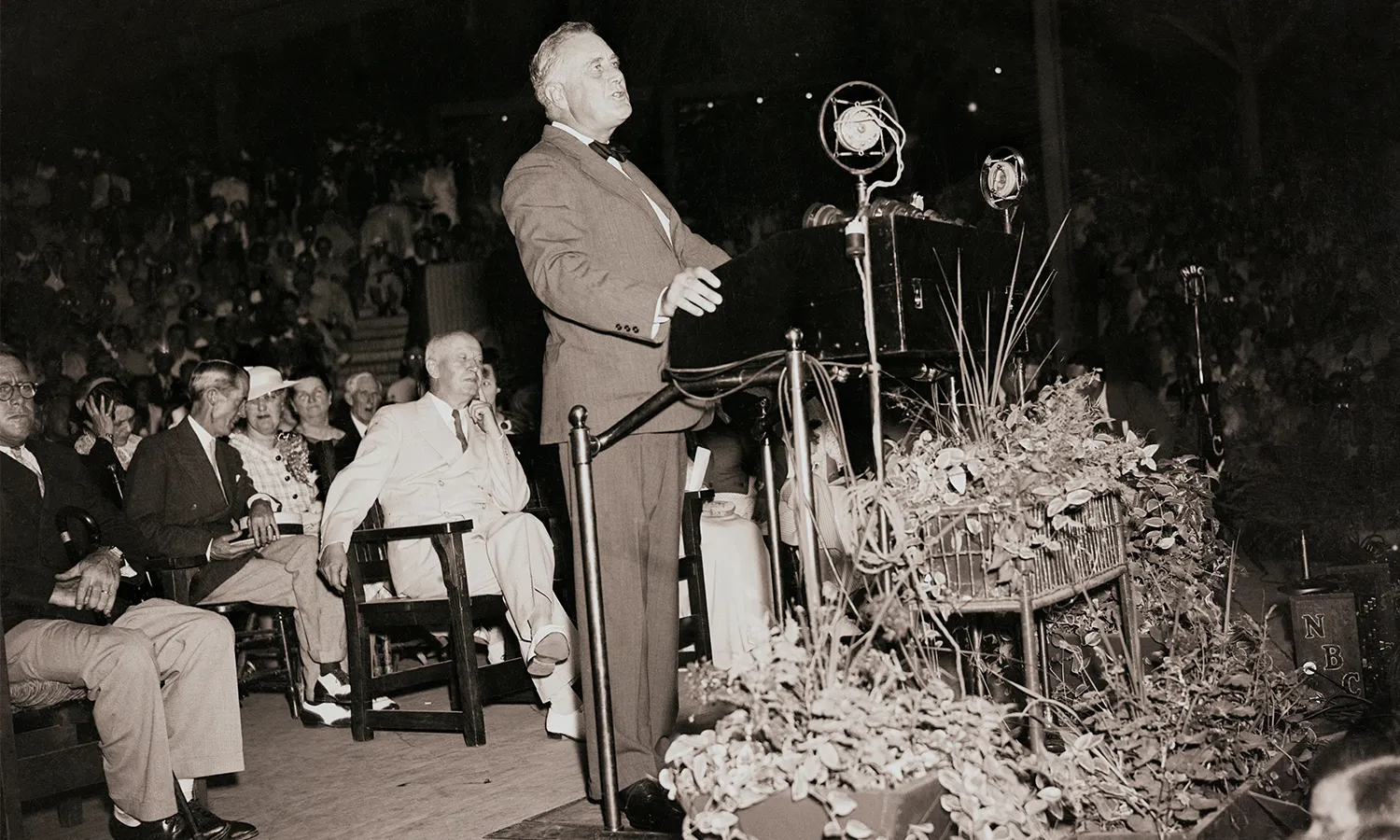
Context: By 1936, President Franklin Roosevelt faced a delicate political challenge. Running for reelection amid strong antiwar sentiment, he needed to reassure voters that he shared their determination to avoid another European conflict—while preserving flexibility to respond to a deteriorating international situation. Italy had invaded Ethiopia, civil war had erupted in Spain, and Germany was rearming in violation of the Versailles Treaty. In an August 1936 address at Chautauqua, New York, Roosevelt delivered one of his most famous statements on foreign policy, which came to be known as his “I Hate War” speech.
Excerpt:
We are not isolationists except in so far as we seek to isolate ourselves completely from war. Yet we must remember that so long as war exists on earth there will be some danger that even the Nation which most ardently desires peace may be drawn into war.
I have seen war. I have seen war on land and sea. I have seen blood running from the wounded. I have seen men coughing out their gassed lungs. I have seen the dead in the mud. I have seen cities destroyed. I have seen two hundred limping, exhausted men come out of line—the survivors of a regiment of one thousand that went forward forty-eight hours before. I have seen children starving. I have seen the agony of mothers and wives. I hate war.
I have passed unnumbered hours, I shall pass unnumbered hours, thinking and planning how war may be kept from this Nation.
I wish I could keep war from all Nations; but that is beyond my power. I can at least make certain that no act of the United States helps to produce or to promote war. I can at least make clear that the conscience of America revolts against war and that any Nation which provokes war forfeits the sympathy of the people of the United States.
…
The Congress of the United States has given me certain authority to provide safeguards of American neutrality in case of war.
The President of the United States, who, under our Constitution, is vested with primary authority to conduct our international relations, thus has been given new weapons with which to maintain our neutrality.
Nevertheless and I speak from a long experience the effective maintenance of American neutrality depends today, as in the past, on the wisdom and determination of whoever at the moment occupy the offices of President and Secretary of State.
It is clear that our present policy and the measures passed by the Congress would, in the event of a war on some other continent, reduce war profits which would otherwise accrue to American citizens. Industrial and agricultural production for a war market may give immense fortunes to a few men; for the Nation as a whole it produces disaster. It was the prospect of war profits that made our farmers in the West plow up prairie land that should never have been plowed, but should have been left for grazing cattle. Today we are reaping the harvest of those war profits in the dust storms which have devastated those war-plowed areas.
It was the prospect of war profits that caused the extension of monopoly and unjustified expansion of industry and a price level so high that the normal relationship between debtor and creditor was destroyed.
Nevertheless, if war should break out again in another continent, let us not blink the fact that we would find in this country thousands of Americans who, seeking immediate riches—fools' gold- would attempt to break down or evade our neutrality.
…
At this late date, with the wisdom which is so easy after the event and so difficult before the event, we find it possible to trace the tragic series of small decisions which led Europe into the Great War in 1914 and eventually engulfed us and many other Nations.
We can keep out of war if those who watch and decide have a sufficiently detailed understanding of international affairs to make certain that the small decisions of each day do not lead toward war and if, at the same time, they possess the courage to say "no" to those who selfishly or unwisely would let us go to war.
Of all the Nations of the world today we are in many ways most singularly blessed. Our closest neighbors are good neighbors. If there are remoter Nations that wish us not good but ill, they know that we are strong; they know that we can and will defend ourselves and defend our neighborhood.
We seek to dominate no other Nation. We ask no territorial expansion. We oppose imperialism. We desire reduction in world armaments.
We believe in democracy; we believe in freedom; we believe in peace. We offer to every Nation of the world the handclasp of the good neighbor. Let those who wish our friendship look us in the eye and take our hand.
For more information about President Roosevelt's "Address at Chautauqua, N.Y." on August 14, 1936, or to access the complete speech, visit The American Presidency Project.