Merchants of Death 1934
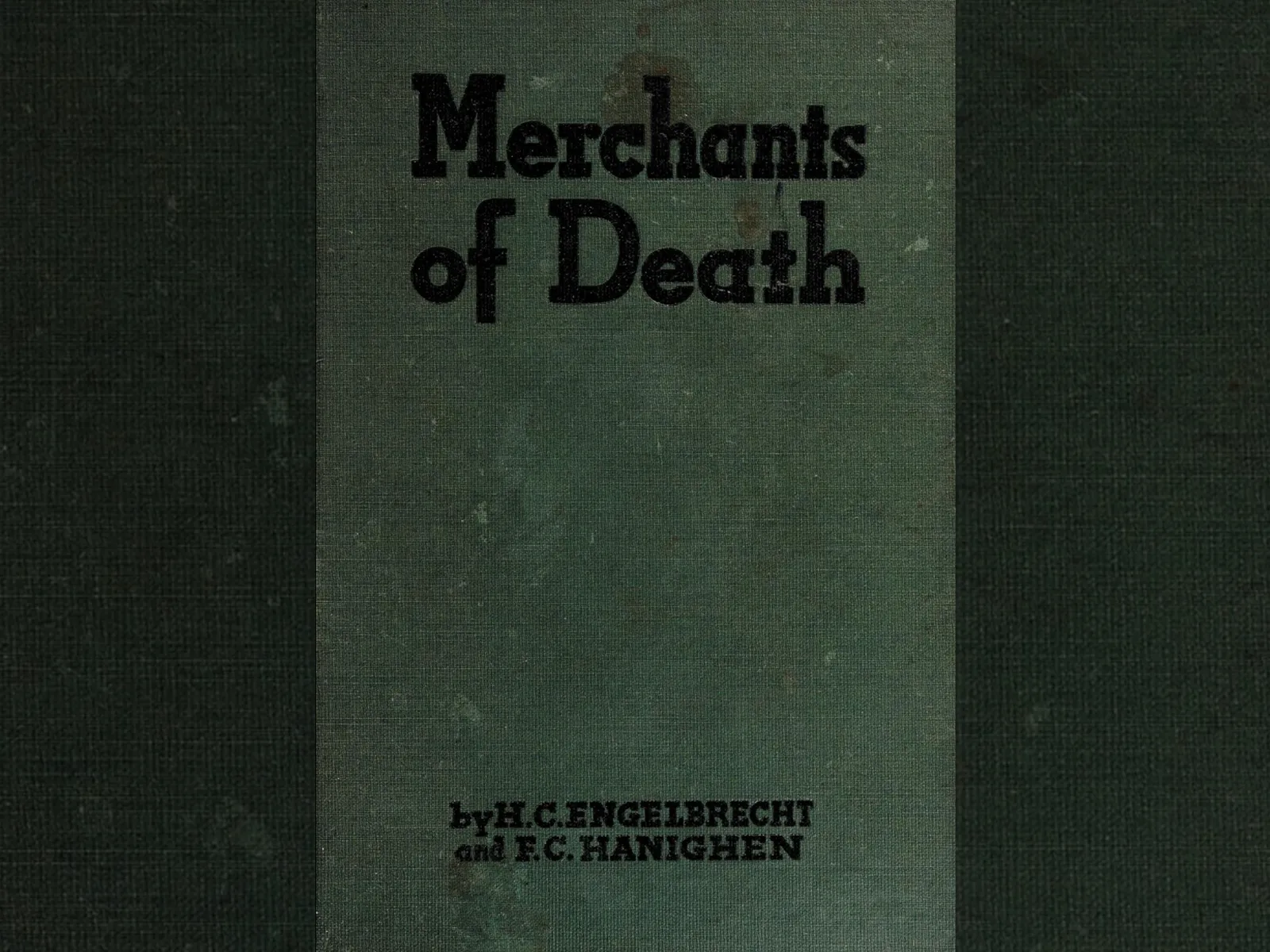
Context: H.C. Engelbrecht and F.C. Hanighen’s 1934 book Merchants of Death: A Study of the International Armament Industry, argued that arms manufacturers and bankers had manipulated the United States into entering World War I to protect their profits. The book crystallized disillusionment with American participation in World War I and fueled calls for strict neutrality if war broke out in Europe again.
Excerpt:
WHEN the World War began in 1914, the President of the United States advised his fellow countrymen to remain neutral even in thought. When the armistice was signed in 1918, there were 21,000 new American millionaires, Du Pont stock had gone from $20 to $1,000 a share, and J. P. Morgan was said to have made more money in two years than the elder Morgan made in all his life.
At the outset, Europe was convinced that the war would not last long and that it would be able to supply its own ammunition for the duration of the conflict. For almost a year Europe did manage to fill most of its needs from its reserves. When it became evident, however, that a long war was probable, new sources of supply were eagerly sought.
The one great power which had remained neutral was the United States. Theoretically, according to international law and the Hague Convention of 1907, both sides in the conflict were permitted to buy from a neutral, and the neutral was privileged to sell. It was not a new situation. In many wars the neutrals had sold to both sides.
Now, however, a new factor entered the picture. Germany was blockaded, at least in theory, and the Allies would not permit neutral commerce to pass the blockade. The list of contraband articles was extended until an absolute blockade existed, and, despite the irritation of the United States, the Allies persisted in this policy. In reality, therefore, the United States was arming and supplying only the Allies.
There was no great and important buying of war materials in the United States by the Allies until the second half of 1915. Then the traffic began in earnest. The Allies established a central purchasing bureau in the States which soon spent on the average of $10,000,000 a day. Between August, 1914 and February, 1917 more than $10,500,000,000 worth of goods were shipped out of America.
Munitions played a prominent part in this traffic. In 1914, exports amounted to $40,000,000, in 1915, they totaled $330,000,000 million, and in 1916 they pyramided to $1,290,000,000. From 1914 to 1918 the Allies bought $4,000,000,000 worth of munitions in the United States. But munitions were by no means the only item of commerce. In a long list of exports, the following are included: Iron and steel, explosives, cotton and cotton manufactures, wheat, copper, brass, leather, chemicals, firearms, automobiles, wheat flour, metal-working machinery, corn, horses, wire manufactures, shoes, railway cars, mules, barley, wool manufactures, tires, airplanes, motor cycles, etc.
The war year 1916 was by far the most prosperous in the entire history of American industry and finance. The enormous volume of foreign trade created something like a shortage at home, and as a result domestic prices began to skyrocket. The golden harvest reaped from American pocketbooks far outweighed the profits from the traffic with the Allies.
There was only one cloud on the horizon: the war might end. Every time there was talk of peace, munitions stocks went down from 5 to 40 per cent. War had brought prosperity, peace threatened to bring calamity. Gradually other worries began to trouble American industry and finance. Suppose the Germans won—what then? No, that could never happen. We have the word of A. D. Noyes, financial editor of the New York Times, that Wall Street picked the Allies to win at the very start and never wavered in this firm belief.
Still, one could never tell. The Germans were making an astonishing stand and in many ways they had a decided military advantage. Suppose the war should end in a stalemate, suppose a "peace without victory" should be concluded? Thoughts like that made Wall Street shudder. American finance had placed its bet on the Allied horse, and if that should fail to reach the post first, the stakes were so enormous that none dared even think of what might happen.
For more information about H.C. Engelbrecht and F.C. Hanighen’s 1934 book Merchants of Death: A Study of the International Armament Industry, click here.