How Did the United States Approach the Tiananmen Square Crackdown?
In this educational video, learn how idealism and realism shaped U.S. foreign policy following the Chinese government’s massacre at Tiananmen Square in 1989.
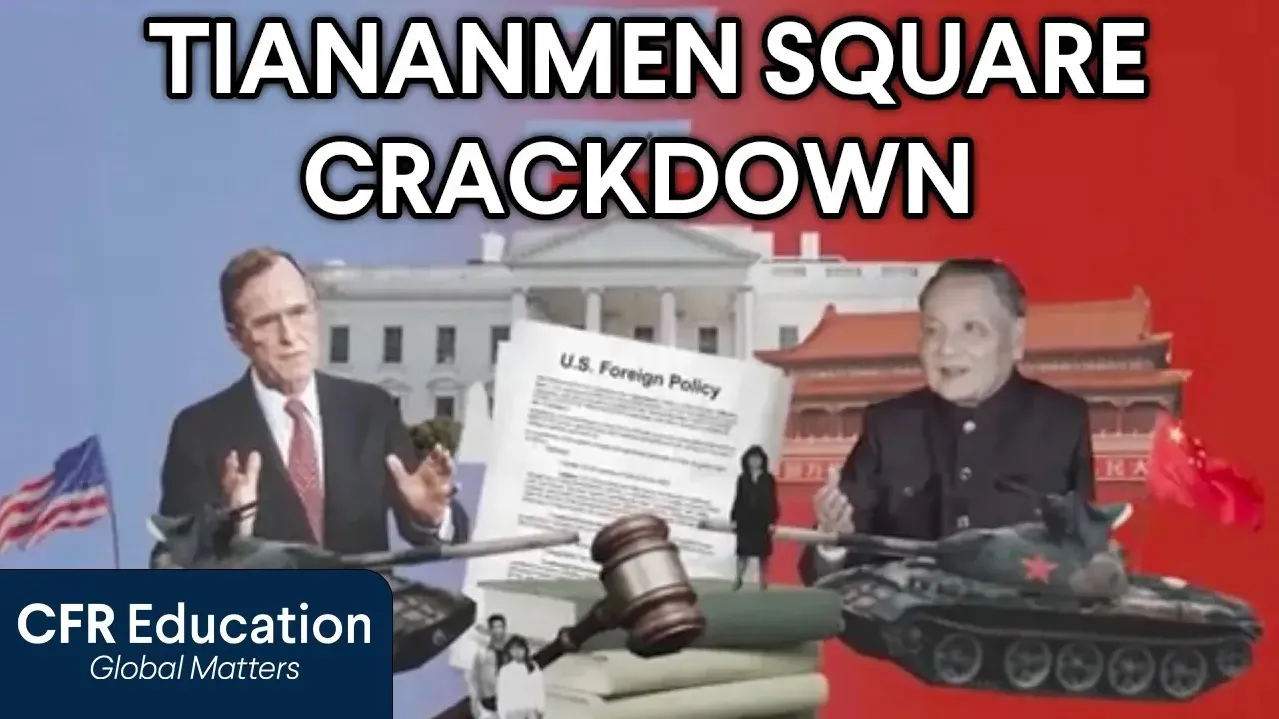
What was the Tiananmen Square massacre?
In 1989, the Chinese government cracked down on pro-democracy protesters in Beijing’s Tiananmen Square, killing hundreds, if not thousands, of people.
U.S. foreign policy: realism vs. idealism
Following the massacre, U.S. policymakers debated how best to respond. The United States could pursue an idealist foreign policy and punish the Chinese government for its clear human rights violations. Alternatively, it could adopt a realist foreign policy and remain relatively quiet to preserve its strategic relationship with the Chinese government. While weighing the potential consequences of each response, the United States also knew it had to act in a timely manner.
Ultimately, the United States combined elements of both approaches in its response.
Transcript: How Did the United States Approach the Tiananmen Square Crackdown?
Foreign policy is often a balancing act, where leaders must weigh various approaches:
Should they practice idealism, promoting their country’s internal values abroad to try influencing how other countries govern themselves? Or should they be guided by realism, seeking to influence how other countries interact with the world, instead of trying to change them internally? These approaches are frequently in tension, and leaders must balance the two when making foreign policy decisions. This tension was evident in the United States’ response to China’s deadly crackdown on pro-democracy protesters in Tiananmen Square in 1989.
Since 1949, China has been ruled by its authoritarian Communist party. In the late 1970s, however, under the leadership of Deng Xiaoping, the country implemented a series of reforms. These included increasing the market’s role in the economy and allowing for more open discussion of political and social issues. In the mid 1980s, groups of university students started advocating for even more political reforms and protested corruption within the Communist party.
In the spring of 1989, many of those students started demonstrating against the government at Tiananmen Square, a public plaza in the center of Beijing, the country’s capital. The government publicly criticized the students for creating disorder, but initially let the protests continue, even meeting with the student leaders to try to convince them to peacefully return to school.
At the same time, many foreign reporters were covering the protests from Beijing, broadcasting sympathetic coverage of the students out to millions of viewers across the world.
There was a debate within the Chinese government about how to handle the protests, but by early June, the hardliners won out. The government decided to send in the military to clear the square, by any means necessary.
Chaos broke out across Beijing, as the military killed hundreds, if not thousands, of students and civilians throughout the city. News of the massacre spread, sparking outrage worldwide. Governments criticized the Chinese government and called on it to stop the bloodshed and to release activists it had arrested.
The United States—led by President George H.W. Bush—quickly suspended its weapons contracts with the Chinese government, stopped meetings between U.S. and Chinese military leaders, and made it easier for Chinese students in the United States to extend their stay. But some American politicians called for even tougher actions against China, such as withdrawing the U.S. Ambassador from Beijing or imposing economic sanctions.
President Bush tried to resist this pressure to come down harder on China, even though the massacre was a clear violation of human rights, because he believed such an idealistic response would undermine his administration’s more realist goals. At the time, the U.S. was still competing with the communist Soviet Union in the Cold War. And despite China also being communist, it had poor relations with the Soviet Union and was working with the United States to counter the Soviets.
Also the U.S. benefited economically from trade with China, which had grown dramatically during the 1980s. So, Bush preferred to prioritize realism in his approach to China, preserving positive relations with the country to benefit the U.S. strategically and economically. However, while presidents lead U.S. foreign policy, Congress has the ability to limit their choices and complicate their decisions.
And after the Tiananmen Square massacre, the American public and Congress were outraged, and they clamored for more idealistic actions that they hoped would force China to grant its citizens more political rights and freedoms. Bush realized there was little chance the U.S. could convince Chinese leaders to stop repressing the activists, who the leaders viewed as a grave threat to their continued rule and to the stability of the country.
Nevertheless, Bush recognized his domestic political reality and attempted to move forward with some idealism while still emphasizing realism. This would prove difficult though, because Chinese leaders were angry at the U.S. for the initial sanctions Bush had already announced in response to Tiananmen Square. They argued the U.S. was interfering in China’s internal affairs.
Bush tried reaching out to Deng directly. While he refused Bush’s calls at first, Deng eventually agreed to receive Bush’s national security advisor, Brent Scowcroft, who carried a message from the president. Scowcroft communicated that Bush still wanted to preserve good relations between the U.S. and China, but he also tried to explain that China’s actions affected U.S. public opinion, which in turn affected Bush’s ability to preserve good relations.
At first, Deng dismissed Bush’s message. But in the following months Bush continued to make friendly overtures to China, and the two countries privately agreed to a series of steps to de-escalate tensions—which would result in the U.S. withdrawing its sanctions against China. Bush tried to protect this process from Congress, successfully vetoing one bill that would have made it easier for Chinese students in the U.S. to apply for new visas or permanent residency.
However, it soon became clear that China continued to persecute political activists, and American anger toward China continued to grow, so Bush yielded to congressional pressure and signed a bill that reinforced the existing sanctions against China. The move deeply angered Chinese leaders and halted efforts to resolve the tensions over Tiananmen Square, even as the two countries maintained a productive relationship on other matters.
When making foreign policy, leaders often face tough decisions and must weigh competing priorities and goals. But whether they’re trying to influence another country’s internal behavior or external relations, even the most powerful countries often do not have the ability to force another country to change course, and even the most considered approach can come up short.
Learn More


