Global Development Explained
How do governments help people everywhere become healthier and wealthier? Many countries have made great strides in global development progress but challenges remain.
The world is healthier and wealthier today than ever before. As the world has become more connected and technologically advanced, some countries have made drastic improvements in core areas of human and economic development. For example, life expectancy and economic growth have expanded significantly over the 20th and 21st centuries. Some countries have experienced significant economic development driven by new economic policies that encourage trade alongside developmental assistance from countries with larger economies that see strategic value in providing aid. But others, especially those that have experienced political instability, natural disasters, and long-term domestic conflict, have seen less improvement.
So what is development and what is the difference between developed and developing countries? The answer is complicated. Understandings of international development have evolved significantly over time to encompass a range of factors including everything from economic growth and human health and wellbeing to other forms of social and political stability. Terms such as “developing country,” “low- and middle- income country,” and “Global South” are sometimes used to describe certain regions of the world. But the use of these terms today remains a subject of ongoing debate.
It’s easy to think of the world as divided into two groups: developed and developing. But countries that some refer to as developed, including the United States, still have room for improvement. As income inequality rises and climate change threatens the planet, countries are exploring ways to continue the positive trend of global development while paying more attention to equality and environmental sustainability.
Transcript: Global Development Explained
Humans have come a long way, from hunting our food to growing it to ordering it over the phone. Life has gotten easier and better for most of humanity as we’ve built advanced societies with many people leading longer and healthier lives made even better by modern amenities. This process is called development.
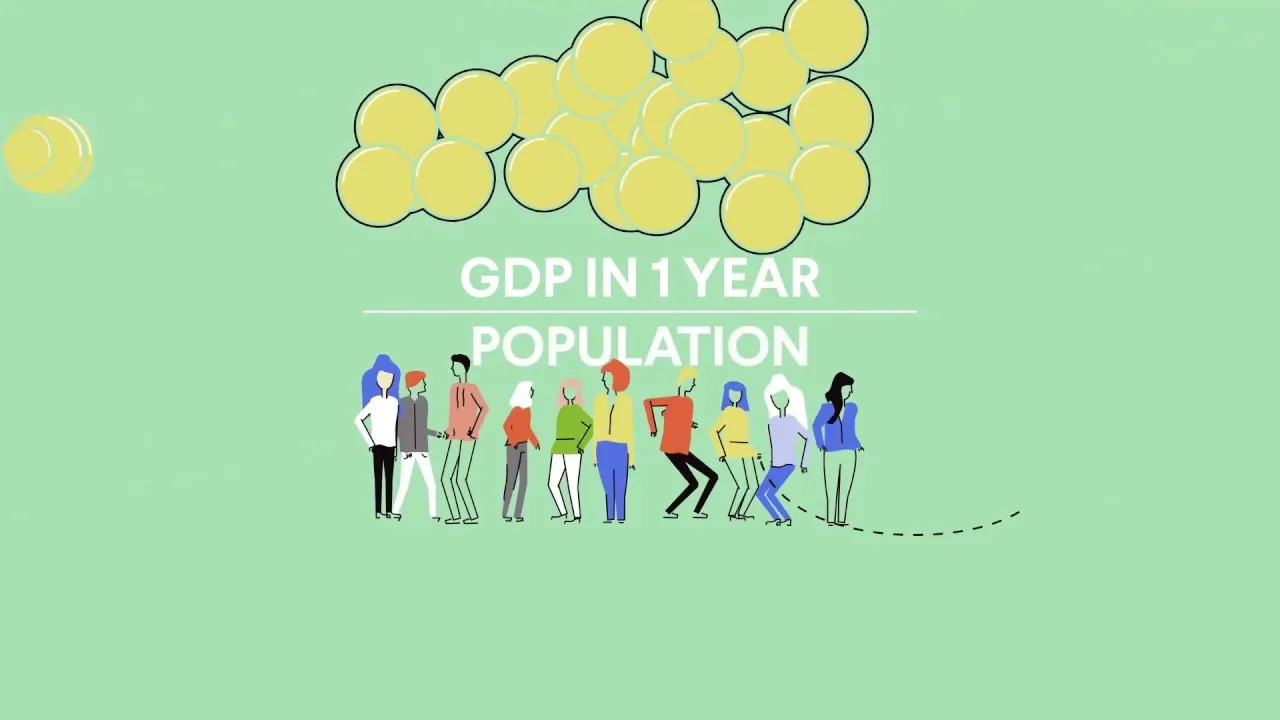
We often hear people divide up the world into developed and developing countries. But what do those labels mean? The best measure is to take the size of a country’s economy, its gross domestic product or GDP, which is the total value of all goods and services, from crops to cars and from waiting tables to writing wills, that are traded or produced within the borders of a country over a period, normally a year, and then divide it by the number of people that live there. This is called GDP per capita.
Some countries with a large GDP have a large population. So their GDP per capita might be relatively low. On the other hand, some countries with a small GDP might have a small population. So their GDP per capita might be relatively high. Countries with high GDP per capita are considered richer and more developed. And countries with low GDP per capita are considered poorer and said to be developing.
So why do some countries have higher GDP per capita than other countries? Well, every country is unique, but there are some important conditions that are required for counties to really grow and sustain healthy economies.
First, there needs to be peace and stability. When people struggle to survive every day, it’s nearly impossible for them to go to work regularly and earn a living.
Second, populations need quality education. If people are able to read and do math, they are likely to be productive workers and savvy consumers. And increasing knowledge fosters innovation and helps spread new technology.
Third, people need access to capital. Starting new businesses and establishing more advanced industries requires money, which can be accumulated domestically over time or sourced from abroad much more quickly.
Fourth, countries need to establish the rule of law, where government officials operate by a written legal code, instead of corruptly helping themselves and the people they like and harming those they don’t like. When the rule of law includes strong property rights, it spurs economic growth. People are more likely to start businesses and work hard when they are able to keep the money they earn, the things they build, and the ideas they invent.
Fifth, there needs to be equality of opportunity. If governments eliminate discrimination against women and minorities, ensuring that businesses and the law treats all people equally, they can participate in the markets they want and can work in the jobs they’re best suited for, unleashing their full economic potential.
Many countries struggle to achieve these five preconditions for economic growth, but other countries frequently offer to step in and help by hosting peace negotiations, funding and supporting education programs, and offering cheap loans for infrastructure projects.
But why would one country care about helping another country grow economically? Well, there are several reasons. Some governments value humanitarianism and simply view it as the right thing to do. We should all try to help our fellow humans no matter where they live. Countries can also help themselves by helping other countries. They can improve their own security. Poor countries are vulnerable to terrorists, pirates, and drug cartels. Those dangerous groups don’t necessarily respect orders and often spread violence and conflict to other countries. But if a country has a growing economy, those violent groups are less likely to form, reducing the security threats for other countries. Another reason countries help other countries is to boost their own economies. If other countries are more prosperous, they could become more beneficial trade partners and can offer new investment opportunities.
But development isn’t just about economics. Since the 1980s, the concept of development has expanded to include humans’ abilities to live their lives the way they want. Are people able to move freely without discrimination? Can they access modern health care and live in environments free of pollution? Do they have political equality and the freedom to speak their minds? The United Nations Development Program works to help countries improve, and it has incorporated this new understanding of development in its mission. Since 2016, the agency has been guided by the UN’s seventeen sustainable development goals, or SDGs, which not only target economic growth but also aim to protect the environment, encourage democracy, and promote equality.
Overall, the world has improved dramatically over the past forty years. Extreme poverty has decreased by 75 percent, the number of students going to school has increased by nearly 50 percent, and the average income has quadrupled. But there are plenty of ways for the world to further develop and for every country to become a better place to live.
Learn More


