Who Counts As a Terrorist?
What are the major types of terrorism? From foreign groups to domestic threats, learn how the U.S. government defines terrorism and its legal consequences.

Terrorist. Terrorist attack. Terrorism. Violent extremism. People hear these words all the time on the news, from law enforcement and from elected officials, especially in the wake of a violent attack. These terms are used widely, but sometimes it’s difficult to tell who qualifies as a terrorist. What separates a terrorist attack from other types of violence? And what actually is terrorism?
Because terrorist threats can come from anywhere—formal groups, individuals, and even countries—and because terrorists can pursue any number of goals, no single definition works in all contexts.
Instead, countries around the world have varying definitions of terrorism and consider different actors terrorists. One widely-used definition from a 2004 UN Security Council Resolution describes terrorism as a criminal act intended to harm or kill, and seeking to intimidate a population or compel a government or international organization to do or not do something. And the United Kingdom’s Terrorism Act defines terrorism to include “an act that can seriously disrupt an electronic system;” thus not requiring physical violence to qualify.
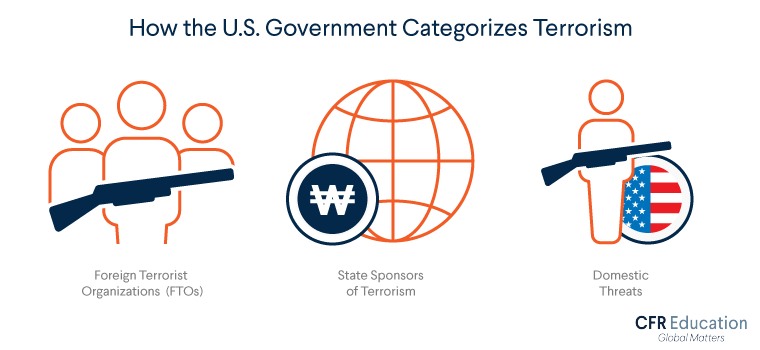
In the United States, various U.S. government departments and agencies place terrorism and related threats into several distinct categories: foreign terrorist organizations, state sponsors of terrorism (countries that finance and support international terrorism), and domestic threats. Understanding these distinctions is important because they reflect a variety of factors, including political considerations. In the United States, these distinct categories of terrorist have different legal consequences.
What are foreign terrorist organizations (FTOs)?
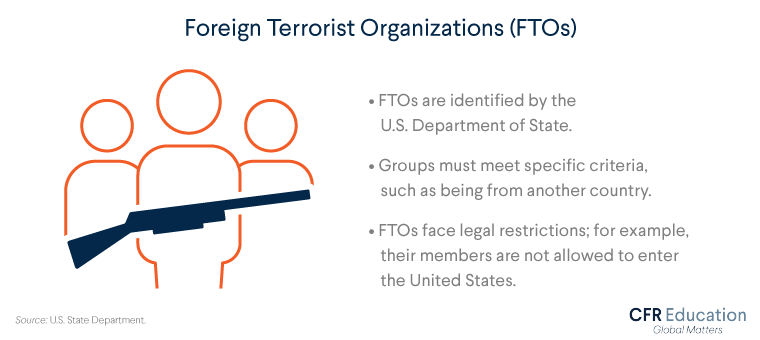
The U.S. Department of State maintains a list of foreign terrorist organizations. This list includes more than eighty groups from all over the world with diverse aims. They include al-Qaeda, the Islamic State (also known as ISIS), two splinter groups of the Irish Republican Army, and others. Organizations are added—or removed—based on whether they meet three criteria:
- the group must be from another country;
- it must engage in terrorist acts as defined by the U.S. government, or have the ability and intent to engage in terrorism; and
- it must threaten the safety of U.S. nationals or U.S. national security—including national defense, relations with other countries, and economic concerns.
The FTO designation carries certain legal consequences:
- It is illegal for any U.S. citizen, or anyone in the United States, to provide terrorist groups with material support. This includes money, housing, false identification, and equipment or weapons.
- U.S. financial institutions can’t house or process funds from FTOs and must report any money from terrorist groups to the Department of the Treasury.
- Members of an FTO are not allowed to enter the United States. If one is already living in the United States, the U.S. government may be able to deport them.
Adding an organization to the list of FTOs is not a decision taken lightly. Terrorist classification often includes political considerations, including relationships with U.S. allies and the allocation of foreign aid. For example, the Taliban in Afghanistan arguably meets the criteria for designation, yet the U.S. government declines to label it a foreign terrorist group (instead of designating it as an “insurgency group"). This is because formally categorizing the group as a terrorist organization would limit the government’s ability to negotiate with the Taliban. This classification would complicate matters, especially given the Taliban’s control over Afghanistan's government. Some have called for the U.S. government to send a firmer message by changing its position and labeling the Taliban a terrorist organization.
In some cases, FTO designations have sparked debate. For instance, in 2025, the Trump administration added over a dozen Latin American gangs and drug cartels to the FTO list. Gangs and cartels have historically been considered transnational criminal organizations (TCOs) because they lack the ideological motivation usually associated with terrorist organizations. They are primarily motivated by profit rather than political objectives. The Trump administration has since carried out military strikes on boats that it alleges were being used by cartels on the list to bring drugs to the United States. The administration has cited the FTO designations in its rationale for the strikes.
What are state sponsors of terrorism?
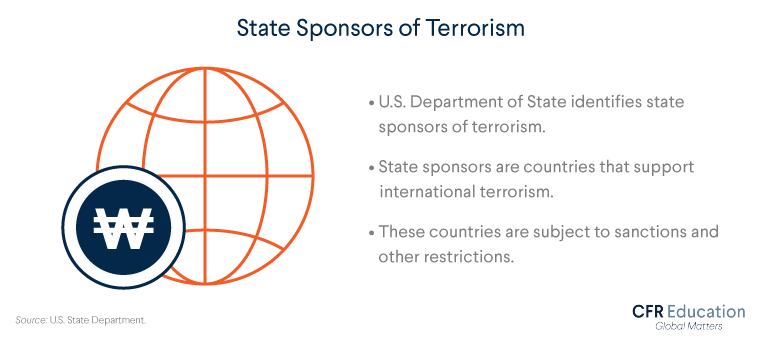
The U.S. Department of State also keeps a list of state sponsors of terrorism. The list identifies countries determined by the U.S. government to have repeatedly provided support for acts of international terror. To determine which countries qualify, the U.S. government uses a specific definition of international terrorism found in U.S. law:
- International means that the act of terror involves the citizens or the territory of multiple countries.
- Terrorism is defined as “premeditated, politically motivated violence” that attacks civilians. This violence is carried out by groups or people acting in secret.
Four countries are currently on the list: Cuba, Iran, North Korea, and Syria. These countries face similar legal restrictions to foreign terrorist organizations, including
- sanctions to prevent these countries from receiving most forms of U.S. foreign assistance (assistance could be anything from deploying Peace Corps volunteers to financing health projects in the country); and
- bans on selling or exporting defense technology—including weaponry, military vehicles, and aircraft—to the countries.
Even if a country is deemed to sponsor terrorism internationally, political considerations still influence its inclusion on the list. After twenty years on the list, North Korea was removed in 2008 as part of a deal to encourage the country to get rid of its nuclear weapons program. In 2017, however, President Donald Trump redesignated North Korea as a state sponsor of terrorism. This decision was also intended to encourage denuclearization but, this time, using the opposite approach. The Trump administration applied sanctions that prevent U.S. aid from going to any foreign governments that help North Korea. Also as a result of the redesignation, foreign governments or people cannot trade with North Korea without sacrificing business relations with the United States.
What is domestic terrorism?
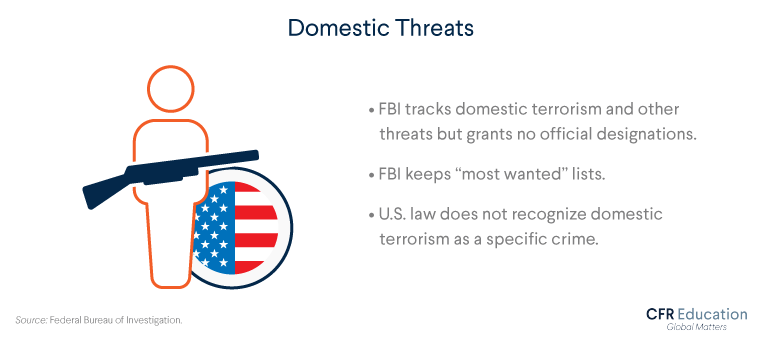
Domestic terrorism is treated differently than international terrorism.
Not all forms of terrorism are transnational or international. Terrorism can originate from within a country, free of international influences. These acts are known as domestic terrorism. A 1995 Oklahoma City bombing, which killed 168 people, is a famous example: it was carried out by two U.S. veterans who held anti-government views. In the United States, domestic terrorist attacks have been on the rise—between 2013 and 2021, the FBI’s number of open domestic terrorism-related cases more than quadrupled.
This means domestic terrorism is also a law enforcement priority. However, its treatment by the U.S. government differs greatly from that of international terrorism: there is no centralized, public, official list of domestic terrorist organizations or sponsors. Tracking domestic terrorism falls primarily to the FBI. The law enforcement agency defines it as “perpetrated by individuals and/or groups inspired by or associated with primarily U.S.-based movements that espouse extremist ideologies of a political, religious, social, racial, or environmental nature.”
Though there is no public list of domestic terrorist organizations or sponsors, the FBI includes known or suspected domestic and international terrorist threats in its Terrorist Screening Database, commonly known as the Terrorist Watchlist. The database is maintained by the Terrorist Screening Center (TSC), a multi-agency organization administered by the FBI. A number of smaller watchlists are derived from it, including the famous “No Fly List,” which prevents individuals from boarding commercial U.S. flights.
What are the consequences of committing terrorist attacks?
Terrorist designations determine the consequences of committing terrorist acts.
The difficulty with defining domestic terrorism does not only limit who gets designated as a threat. It also affects the legal consequences of committing acts of terror in the United States. Under U.S. law, a perpetrator can be explicitly charged with a crime relating to international terrorism but not domestic acts. Even though U.S. government agencies, and laws like the Patriot Act, offer definitions of terrorism, those definitions haven’t been codified into specific crimes.
What this means is that if an investigation into a violent act reveals a political motive and links to an FTO, the perpetrator can be labeled a terrorist and prosecuted under those specific laws. Those laws allow, in part, for much longer terms in prison. That was the case with a 2017 van attack in New York City that killed eight people, because the perpetrator declared allegiance to the self-proclaimed Islamic State. The perpetrator was sentenced to life in prison.
But for domestic perpetrators with no links to FTOs and whose ideology is sometimes harder to prove, the consequences are different. The federal government has no laws specifically for prosecuting domestic terrorism (although several states do). Instead, individuals are charged with murder, assault, or other violent crimes. For example, the perpetrator of a 2018 mass shooting in a Pittsburgh synagogue, who was motivated by antisemitic ideology, was charged by the federal government with murder and other crimes—not domestic terrorism.
Some experts argue that the distinction in U.S. law enforcement between domestic and international terrorist threats is not always applied equally. They argue, for example, that Muslims in the United States are frequently considered international terrorist threats, even when they have few foreign ties. Because laws governing international terror threats are more expansive, this bias can mean Muslims face harsher policing and punishment than white nationalists and other individuals considered domestic terrorist threats.
A new frontier of threats: lone wolves and mass shooters
Another common term in debates over terrorism is lone wolf or lone actor. The term is used to describe attackers who seem not to be officially connected to a terrorist organization (even if they were possibly inspired by one). Lone wolf perpetrators seem to independently commit acts of violence—for example, the police used the term to describe the perpetrator of a 2017 mass shooting that killed fifty-eight people in Las Vegas. It’s used to distinguish people and events like the Las Vegas shooting from those like the 9/11 attacks, which were several sophisticated, well-funded, organized terrorist attacks carried out simultaneously by multiple people.
Lone wolf is a controversial term among experts for several reasons. Some find it misleading, arguing that people have to be radicalized somewhere. And individual attackers may be tied to broader movements or ideologies—like white supremacy—even if they are not part of specific groups. If an attacker is inspired by propaganda, such as explicit calls to violence, can they be considered lone wolves? CFR fellows Bruce Hoffman and Colin P. Clarke have suggested the concept of "post-organizational violent extremism and terrorism," as a means of describing these acts in cases not consisting of an organizational structure. Other experts also assert that the term lone wolf is glamorizing and should thus be avoided. According to the FBI’s 2021 Strategic Intelligence Assessment and Data on Domestic Terrorism report, “the greatest terrorism threat to the Homeland we face today is posed by lone offenders, often radicalized online, who look to attack soft targets with easily accessible weapons." Moreover, lone wolf attacks tend to be harder to predict and prevent given their more isolated nature.
Mass shootings are another major concern and threat in the United States; some experts include them as a form of terrorist threat, especially when they are motivated by extremist ideology. Although mass shootings constitute the majority of instances of mass violence in the United States, not all mass shooters are considered domestic terrorists. Experts continue to debate how best to classify different forms of mass violence in the United States.
But mass shooter incidents weaken the United States' ability to speak on violence in other countries. U.S. adversaries sometimes highlight the rise of mass casualty gun violence in the United States as a point of weakness and hypocrisy. They ask how the United States can comment on the security of people in other nations, when they cannot even protect U.S. citizens. The United Nations, as well as NGOs such as Human Rights Watch and Amnesty International, have called for stronger policy responses to address the prevalence of U.S. gun violence.
Who counts as a terrorist and what counts as terrorism is a debate that remains unresolved.
It’s important to remember that describing something as terrorism doesn’t necessarily make it so legally. Eagerness to precisely define or categorize an attack or attacker in the wake of an event can lead to confusion and debate over what qualifies as terrorism. At the same time, defining and classifying terrorism remains an important factor in establishing how governments approach the issue and what tools they have at their disposal to address it. As the landscape of terrorist threats continues to shift, questions over what counts as terrorism and who counts as a terrorist will persist.