What Is Migration?
Why do people migrate? Understand why migration means different things for individuals, countries, and economies in a globalized world.
The movement of people away from their place of usual residence—known as migration—has long shaped human history. These patterns, which involve many types of movement, including across international borders or inside a country, have occurred for millennia, shaped by evolving economic and political challenges and opportunities.
There are more than 300 million migrants today, representing the highest number since World War II, and possibly ever. Migrants leave their homes for diverse reasons. They may be
- seeking better jobs and access to better health care;
- running from famine, war, or natural disasters; or
- fleeing persecution and looking for political and religious freedoms they do not enjoy at home.
Often, a combination of these factors pushes people to leave and pulls them toward their new homes, and international organizations provide a range of legal concepts and protections aiming to protect different groups of migrating people.
While migration today shows no sign of ceasing, many countries are either unable or unwilling to meet this standard. The world needs to not only consider how to welcome migrants but also address the factors pushing them to migrate in the first place.
Why does migration matter?
Though migration is not a new phenomenon, it takes on a new significance in an increasingly interconnected world shaped by new global challenges, such as climate change, the rise of technology, and protracted modern conflicts. Understanding what migration is—who migrates, where they come from, and where they settle—and what causes migration—both the crises and the opportunities—can affect our understanding of critical issues such as national security, economics, climate change, global health, and more.
As the number of migrants continues to grow for various reasons, it is important to understand how migration shapes the world socially, economically, and politically—and, in turn, how countries shape immigration policy in response.
Transcript: What's the Difference Between a Migrant and a Refugee? Migration Explained
More people are migrating than ever before, posing enormous challenges and opportunities for individuals, countries, and the entire world.
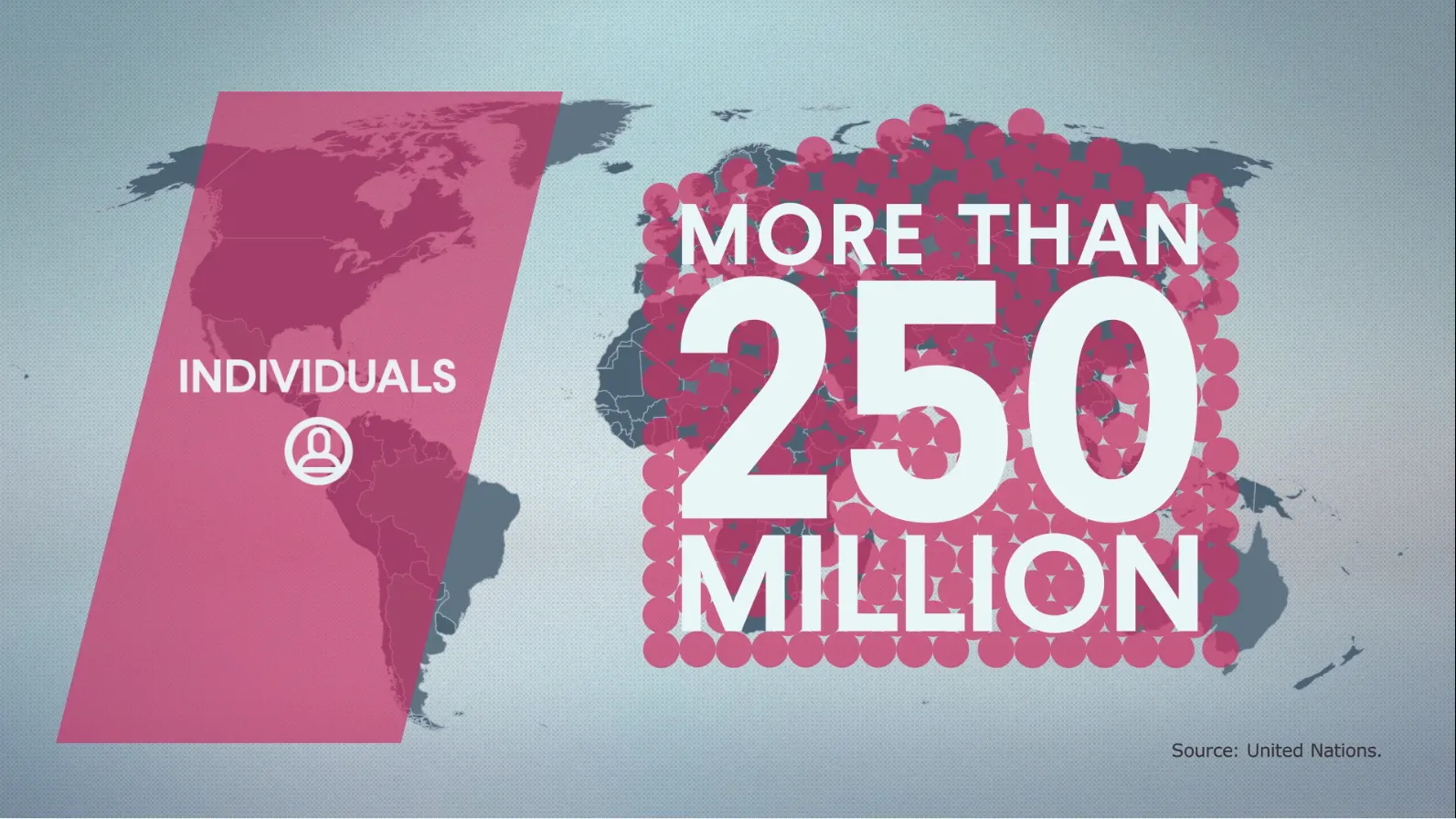
Now, more than 250 million people live outside their country of birth.
Most of them are economic migrants, who leave their home countries seeking better jobs and economic opportunities abroad.
They’re also fleeing persecution, often blurring the line between economic migrants and refugees. But the distinction between the two has major consequences.
In 1951, an international convention legally defined refugees as people who have fled their home country due to a well-founded fear of being persecuted because of their race, religion, nationality, or membership of a particular social group or political opinion. It gave them specific rights and protections, including access to health care and education.
But this definition doesn’t account for every refugee. Many people are increasingly displaced by natural disasters and climate change. And despite the international convention, it’s typically individual countries that decide whether to recognize migrants as refugees and grant them legal protections.
An asylum seeker is a person who has requested recognition as a refugee and whose claim has not yet been assessed, a process that can take years.
Not all migrants are willing or able to leave their home countries. Internally displaced persons make up one of the largest migrant groups and are uniquely vulnerable.
Home governments are responsible for protecting IDPs but are often the very source of the conflict or persecution they’re fleeing.
And intervention by foreign governments and organizations is challenging because of sovereignty, the principle that individual countries should generally have complete authority within their borders.
Most countries focus their migration policies on controlling who enters, citing economic, values, and security concerns.
A growing trend over the past few decades is the militarization of border security, as migrants are viewed as potential threats.
On this front, many nations are following the example of the United States, which also performs extensive vetting of migrants, requiring comprehensive interviews and biometric testing.
Beyond security, some policymakers object to immigrants on racial and religious grounds, but others welcome them, touting diversity and human rights. Still, critics of large-scale immigration say that migrants are a burden for government services and that they take jobs away from native-born workers.
However, migrants can provide a major boost to countries’ economies, filling labor and skill gaps, while bringing new ideas and an entrepreneurial spirit. Over 40 percent of Fortune 500 companies were founded by immigrants or the children of immigrants.
While the migrants’ home countries may lose talented individuals, they benefit from money sent back to family and friends.
The main organization working to address migration on an international level is the Office of the United Nations High Commissioner for Refugees, which aids and advocates for millions of refugees across the world. But the organization relies solely on voluntary contributions, and resources are limited.
Some governments coordinate with each other on migration issues. In 2016, huge numbers of migrants were flowing from Syria through Turkey into Greece. But Turkey and the European Union struck a deal allowing Greece to send undocumented migrants back to Turkey. In exchange, Turkey would send some vetted Syrian refugees to Greece for resettlement in the EU, which also provided billions of dollars’ worth of economic aid to Turkey as part of the deal.
Still, as governments work together, their decisions must not only address whether and how to accept the incoming flows of migrants, but also other factors — including war, famine, and economic opportunity — that drive these millions of people to move in the first place.