The UN Charter: Five Pillars for Humankind
Introduction
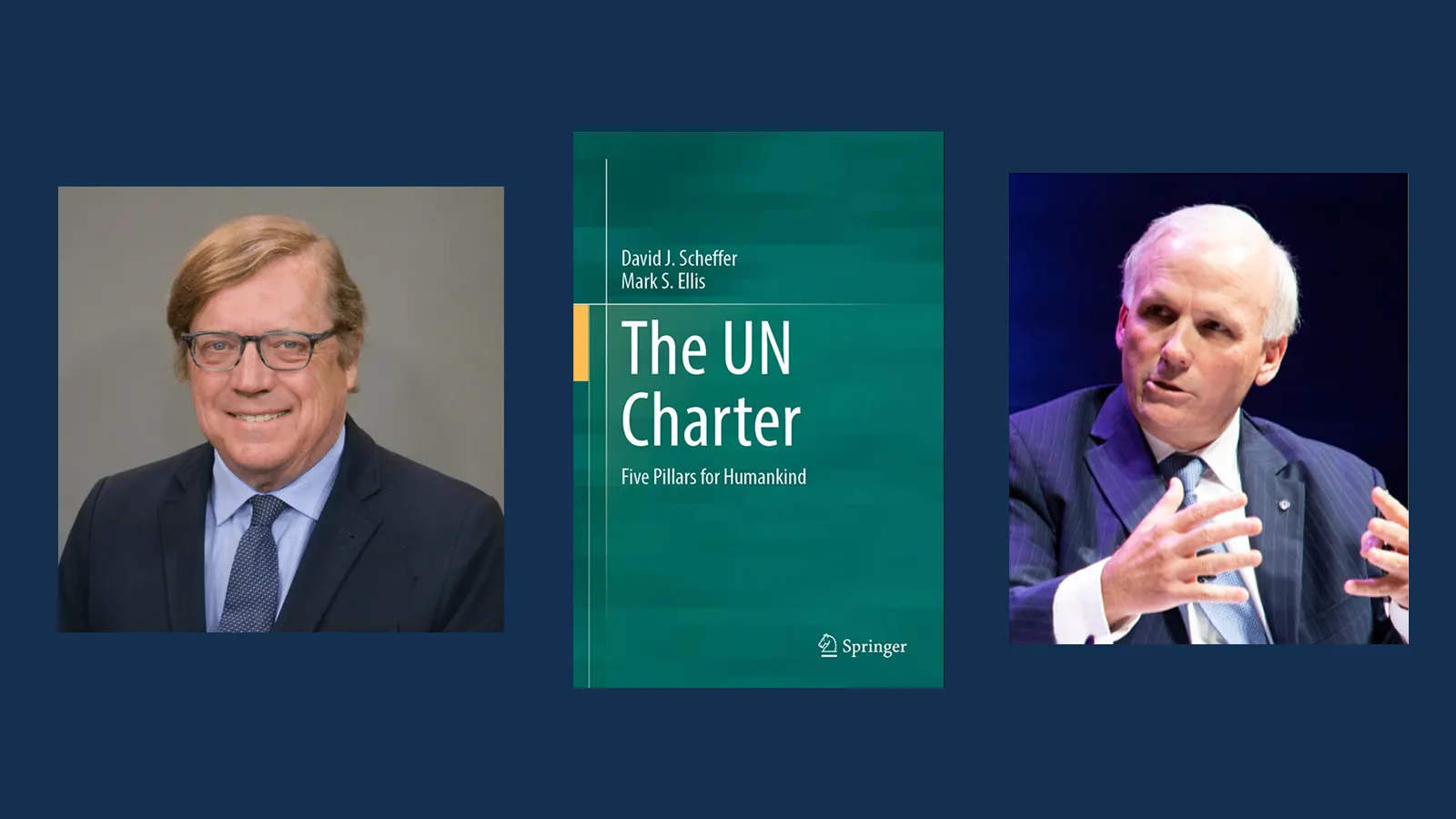
The UN Charter: Five Pillars for Humankind reintroduces the United Nations Charter as the most important secular document in the world because the Charter is essentially the constitution of global governance to which all nations are bound, even if not always in practice. In the book, co-authors David J. Scheffer and Mark S. Ellis explain the core principles embedded in the Charter and introduce pragmatic interpretations of key Charter provisions to modernize its application both today and in the future.
Summary
After World War I, the Covenant of the League of Nations created what people today think of as multilateralism. However, the ultimate lack of American ratification left the League of Nations without some much-needed legitimization. The League’s ineffectiveness at preventing or restraining armed conflict led to a second World War only two decades later. During World War II, the Allied powers discussed the need for a stronger organization well-equipped to end wars before they began. The drafting of what would become the UN Charter began in 1944 at the Dumbarton Oaks Conference and was finalized and signed at the 1945 San Francisco Conference. Two months after the end of the war, the UN Charter was ratified on October 24, 1945, bringing the treaty into full force. The League of Nations formally disbanded the following year.
The Preamble of the UN Charter sets the basic objectives of the new organization, now celebrating 80 years as an institution. The first of these objectives is “to save succeeding generations from the scourge of war, which twice in our lifetime has brought untold sorrow to mankind,” followed by other aspirations such as preserving human rights, maintaining international peace and security, promoting economic and social advancement, and of course, prefacing the text that would establish the organs to achieve these goals and others.
The UN Charter requires that UN membership be open to “peace-loving states” willing to carry out the obligations of the Charter. These states would then be responsive to the work of the organs of the UN, which comprises six main bodies: the General Assembly, the Security Council, the Economic and Social Council, the now-defunct Trusteeship Council, the International Court of Justice, and the Secretariat. The UN system is also joined by over a dozen specialized UN agencies, such as the World Health Organization, the World Bank Group, and the International Monetary Fund, whose integration with the United Nations is explained through Articles 57 and 63 of the Charter.
While UN member states may not always live up to the “peace-loving” expectations of the UN Charter, this document is a milestone in human history for its impact over the last 80 years in providing an international structure of governance like none that has existed before. The UN Charter: Five Pillars for Humankind helps the reader see why its continued study is central to the understanding of international relations in the past, present, and future.
This book is suitable for undergraduate and graduate courses in the following disciplines:
- Political Science
- International Relations
- World Affairs
- International Law
Main Takeaways
- The UN Charter is the only secular document that governs all of the citizens of the world, and as such, it is critical to understand the Charter in order to understand the complexities of international relations.
- Preservation of human rights and freedoms are central to the tenets of the UN Charter because without those objectives, the Charter would be nothing more than a document of security pledges to preserve state sovereignty.
- The continuing evolution of international law will be increasingly influenced by states in the “Global South.”
- Effective prevention and mitigation of conflicts, as well as the meaningful promotion of economic and social progress, can be achieved through a stronger will among member states at taking collective action and responsibility.
- The UN Charter contains provisions for greater expansion of its peacekeeping and peace enforcement duties than what member states have been doing in practice.
Discussion Questions
For undergraduate courses in Political Science, International Relations, and World Affairs:
- Why is it important for states to have an international system of governance?
- What internal challenges do states face when committing to international obligations?
- What are some of the ripple effects around the world since 1945 as a result of the influence of the UN Charter?
- How can the foundation established by the UN Charter be improved pragmatically for future generations?
- Is it realistic to expect significant reforms within the United Nations system, or would a more effective approach be to amend the text of the UN Charter? Why?
For graduate courses in Political Science, International Relations, and World Affairs:
- Why is the "secular" distinction relevant when Scheffer and Ellis describe the UN Charter as "the world's most secular document"? How has the UN Charter been more or less influential than other keystone documents (secular or non-secular) with regards to global governance?
- Scheffer and Ellis describe five pillars when discussing how the UN Charter can be reinterpreted for the modern day. What are the five pillars? Which pillar do you think is the most easily achievable and why? Which do you think is the most difficult to achieve and why?
- What are some ways that the UN Charter has influenced future work on advancing human rights by virtue of the mechanisms which it helped to create?
- What could be some of the immediate impacts of the Security Council taking on the authority de jure that it has never used to maintain international peace and security?
- How could an activist General Assembly use Article 14 of the UN Charter in a more meaningful way? What real-world current crises could benefit from this expansion of current norms?
For undergraduate and graduate courses in International Law:
- How would you describe the importance of international law in strengthening peace and security, which is a primary aim of the UN Charter and the United Nations system?
- As drawn from the Dumbarton Oaks Proposals and then embodied in the UN Charter, what are some of the key characteristics describing the International Court of Justice?
- The creation of the International Law Commission (ILC) was enabled by the UN Charter and has developed many multilateral treaties over decades. How have the ILC and these treaties advanced the growth of international law?
- What are a few initiatives that could be undertaken to strengthen respect for international law among nations and peoples?
Essay Questions
For undergraduate courses in Political Science, International Relations, and World Affairs:
- Pick two of the five pillars introduced by Scheffer and Ellis when discussing the modern applications of the UN Charter. Explain how UN member states can achieve the objectives of these two pillars through pragmatic reinterpretation of the Charter’s language instead of amending it outright.
- Pick one of the six organs of the United Nations and explain how Scheffer and Ellis’ analysis of the UN Charter and proposals to modernize its understanding can be used to improve that organ’s ability to achieve the objectives of the Charter.
For graduate courses in Political Science, International Relations, and World Affairs:
- Pick three of the five pillars introduced by Scheffer and Ellis when discussing the modern applications of the UN Charter. Explain how UN member states can achieve the objectives of these pillars through pragmatic reinterpretation of the Charter’s language instead of amending it outright.
- Pick two of the six organs of the United Nations and explain how Scheffer and Ellis’ analysis of the UN Charter and proposals to modernize its understanding can be used to improve those organs’ ability to achieve the objectives of the Charter.
For undergraduate and graduate courses in International Law:
- Select one international treaty arising from the work of the International Law Commission (ILC) as depicted by Scheffer and Ellis and explain what you consider to be that treaty’s value in the development and enforcement of international law. Remember that the Genocide Convention was not a product of the ILC.
- Examine the description by Scheffer and Ellis of the Genocide Convention and describe what you consider to be the treaty’s positive and negative characteristics, particularly in light of the perpetuation of the crime of genocide into the modern era.
Supplementary Materials
Simon Chesterman, Ian Johnstone, and David M. Malone, Law and Practice of the United Nations: Documents and Commentary, 2nd ed. (Oxford University Press, 2016).
Paul Kennedy, The Parliament of Man: The Past, Present, and Future of the United Nations (Random House, 2006).
Mark Mazower, Governing the World: The History of an Idea (Penguin Press, 2012).
Stephen C. Schlesinger, Act of Creation: The Founding of the United Nations (Westview Press, 2003).
Bruno Simma et al., eds., The Charter of the United Nations: A Commentary, 4th ed. (Oxford University Press, 2024).
“United Nations Charter,” United Nations. (This document appears at the end of The UN Charter: Five Pillars for Humankind.)