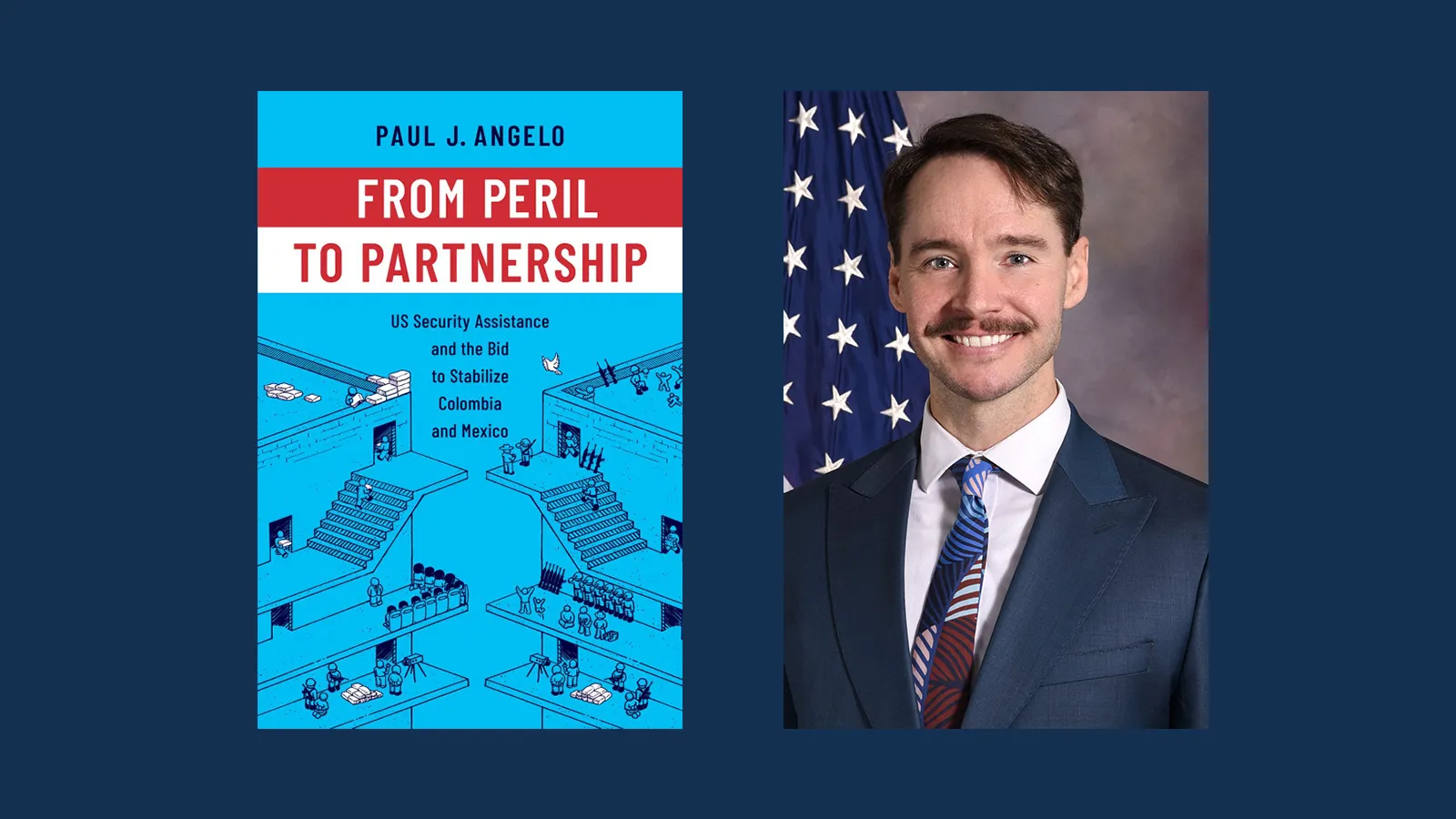
From Peril to Partnership: U.S. Security Assistance and the Bid to Stabilize Colombia and Mexico
Introduction
From Peril to Partnership: U.S. Security Assistance and the Bid to Stabilize Colombia and Mexico evaluates to what extent security assistance programs helped improve the operational effectiveness and democratic accountability of Washington’s leading Latin American security partners—Colombian and Mexican security forces. The book answers why Plan Colombia (2000-11) achieved its objectives and why the Mérida Initiative (2007-16) underdelivered in Mexico, providing insights into the efficacy of U.S. security assistance and the necessary conditions and stakeholders in partner nations that facilitate success.
Summary
Plan Colombia and the Mérida Initiative are the two most significant U.S. security assistance efforts in Latin America in the twenty-first century. At a time when U.S. objectives in the Middle East and Central Asia were flagging, Colombia was a rare U.S. foreign policy victory—a showcase for stabilization and security sector reform. Conversely, Mexico struggled to turn the tide on the country’s scourge of crime and violence, even with an influx of resources aimed at professionalizing the country’s security, defense, and judicial institutions.
From Peril to Partnership offers a rigorous comparative study of U.S. foreign policy toward the United States’ most prominent Latin American security partners in the twenty-first century, addressing the divergent trajectories of security cooperation efforts in the Western Hemisphere. The book addresses the fundamental question of why massive infusions of U.S. capital and training successfully bolstered state capacity in Colombia while failing to prevent a descent into unprecedented violence and institutional decay in Mexico.
The book highlights three domestic factors in the recipient countries—Colombia and Mexico—that affected the ability for U.S. foreign aid to deliver national and regional stability. First, private-sector involvement in supporting security sector reform in Colombia generated national buy-in and the resources to sustain security strategies and capabilities over time. In contrast, Mexico’s business class remained insulated and fragmented, failing to provide the fiscal or political backing for comprehensive reform at the federal level.
Second, political polarization and the subsequent politicization of security as an electoral issue denied Mexico the continuity needed to sustain security sector reform across successive presidential administrations, despite the consistency of Mérida Initiative programming and U.S. support. In Colombia, the convergence of major political parties on security policy to address an existential threat to the state resulted in a public mandate to pursue an aggressive security strategy enabled by Plan Colombia resources.
Third, security sector centralization affected the degree to which U.S. partner security forces adopted new practices, resources, and technology. Whereas Colombia’s unified and highly centralized command structure allowed for efficient and transparent aid absorption, Mexico’s decentralized and often corrupt subnational police forces proved resistant to top-down professionalization, undercutting the effectiveness of investments made at the national level.
From Peril to Partnership posits that private-sector contributions, legislative agenda-setting, and whole-of-government agenda setting are top facilitators of security sector reform in U.S. partner nations. It answers why Plan Colombia achieved its objectives and why the Mérida Initiative underdelivered in Mexico. Most importantly, it goes beyond drug war theatrics and the “one-size-fits-all” approach to U.S.-led stabilization—at once, restoring agency to institutions on the receiving end of U.S. security assistance and helping chart a course toward more nuanced and effective U.S. policy.
This book is suitable for undergraduate and graduate courses in the following disciplines:
- Political Science
- Comparative Politics
- International Relations
- Latin American Studies
- Latin American History
- Diplomatic History
- Security Studies
- Development Studies
Main Takeaways
- U.S. security assistance can be an important facilitator of security sector reform but usually where there is national buy-in from a partner government.
- Security assistance that emphasizes institutional professionalization and democratic accountability improves the chances of enduring reform.
- The United States can achieve stabilization objectives through security assistance in lieu of large-scale military occupation.
- Stability, prosperity, and democratic governance in Latin America and the Caribbean contribute to U.S. national security.
Discussion Questions
For courses in Political Science/Comparative Politics/International Relations:
- If centralized power is more efficient for absorbing security assistance but also poses a risk for the checks and balances prescribed by many democratic constitutions, how should policymakers balance the needs for operational effectiveness and institutional accountability?
- If security assistance success rests on the financial and political buy-in of a country’s elites, does this necessarily imply that U.S. security assistance is fundamentally a tool for elite stabilization? To what extent does this undercut democratic governance?
For courses in Latin American Studies/Latin American History:
- In Mexico, the cultural memory of the 1847 U.S. invasion and subsequent territorial loss remains a foundational pillar of national identity. In contrast, Colombian elites have often looked toward the United States as a strategic partner against internal insecurity. How do these distinct historical imaginaries shape the cultural acceptance of U.S. security assistance? Does the professionalization of a Latin American military by U.S. advisors represent a voluntary hybridization of national identity, or a subversion of it?
For courses in Diplomatic History/Security Studies/Development Studies:
- Development literature often debates whether security must precede sustainable development or if development is necessary for enduring security. How do Plan Colombia and the Mérida Initiative fit into this dichotomy?
- To what extent can security assistance be viewed as a "resource curse" that allows elites in a recipient country to avoid the politically difficult task of taxing themselves and building an enduring social contract?
Essay Questions
For courses in Political Science/Comparative Politics/International Relations:
- If the Mérida Initiative failed because of Mexico’s fragmented federalism, does this imply that federalist systems are inherently less capable of surviving challenges from transnational criminal organizations than unitary states?
- Based on the criteria for successful security assistance and security sector reform presented in the book, is X country (Ecuador, perhaps) a fruitful national context for a robust U.S. security assistance initiative?
For courses in Latin American Studies/Latin American History:
- To what extent does the failure of the Mérida Initiative reflect a historical inability of the Mexican state to fully subordinate regional power centers to the federal government? Contrast this with Colombia’s history of "La Violencia" and its subsequent drive toward state consolidation.
- How do Plan Colombia and the Mérida Initiative fit into the broader arc of U.S.-Latin American relations? Do they represent continuity or departure from previous U.S. foreign policy?
For courses in Diplomatic History/Security Studies/Development Studies:
- Compare the diplomatic styles of the Uribe and Calderón administrations. To what extent is modern diplomacy moving away from high-level statecraft toward a model of integrated bureaucracies, in which domestic agencies (like the Pentagon, INL, DEA, and Treasury) act as the primary diplomats?
- Discuss how the nature of the threat (a centralized insurgency in Colombia vs. decentralized, market-driven criminal franchises in Mexico) dictates the success of security assistance. Should U.S. "train and equip" missions move away from decapitation tactics toward more sustainable community policing practices?
Further Projects
- Host a mock country team or interagency meeting in which various U.S. executive agencies or departments present their contributions to a whole-of-government security assistance effort in a partner nation, taking cues from the National Security Strategy, congressional hearings, and U.S. law.
- Stage a debate with the following resolution: The United States ought to condition security assistance on a recipient country’s adherence to democratic principles and human rights standards.
Supplementary Materials
Paul J. Angelo, “A Less Lethal Latin America: Smarter U.S. Security Assistance Can Make the Region Safer,” Foreign Affairs, September 11, 2024.
Paul J. Angelo, “A ‘Plan Ecuador’ is Needed: U.S. Assistance Should Draw Lessons from the Past,” War On the Rocks, February 5, 2024.
Ryan Kertis, “From Peril to Partnership: A Q&A with Author Paul Angelo,” Irregular War Initiative, March 28, 2024.
“From Peril to Partnership with Paul Angelo,” Center for Strategic & International Studies, April 25, 2024 (YouTube).
Jason H. Campbell, Stephen Dalzell, Anthony Atler, Mary Avriette, Jalen Zeman, Kevin J. Connolly, “U.S. Resourcing to National Security Interests in Latin America and the Caribbean in the Context of Adversary Activities in the Region,” RAND Research Report, April 28, 2022.
Elizabeth M. Bartels, Christopher S. Chivvis, Adam R. Grissom, Stacie L. Pettyjohn, “Conceptual Design for a Multiplayer Security Force Assistance Strategy Game,” RAND Research Report, February 7, 2019.
Angélica Durán-Martínez, The Politics of Drug Violence: Criminals, Cops, and Politicians in Colombia and Mexico (Oxford: Oxford University Press, 2018).
Sarah Zukerman Daly, “Why Sheinbaum May Take a Different Path on Mexico’s Security,” Americas Quarterly, October 1, 2024.
Ricardo Ávila, “Maduro’s Fall May Shape Colombia’s Election,” Americas Quarterly, January 12, 2026.