
The United States and Israel launched a major assault on Iran on February 28. In response to the strikes, during which Iranian Supreme Leader Ayatollah Ali Khamenei and other top leaders were killed, Iran has launched retaliatory attacks throughout the region. While a ceasefire was declared in April, sporadic clashes continued to punctuate negotiations. On June 14, the United States and Iran reached an agreement to end the conflict, which is to be signed on Friday, June 19. But experts have cautioned that, as several issues remain unresolved, hopes of this agreement leading to lasting peace could be premature.
The situation in the Middle East is evolving rapidly. To help your students think critically about the news they see, whether on TV, TikTok, or elsewhere, they need a basic understanding of U.S.-Iran Relations and foreign policy. In this blog, you will find timelines, readings, and simulations to help you ground your students in history and foundational concepts so they can evaluate the developing conflict and form their own opinions about the evolving situation.
For the latest coverage, check out the Council on Foreign Relations’s hub for Iran content.
What Should My Students Know About Iran's Modern History?
During World War II, Iran was occupied by Britain and Russia. In 1953, U.S. and British intelligence agencies helped elements in the Iranian military overthrow Iran’s prime minister. The coup reinstated the Western-friendly monarchy, headed by Shah Mohammad Reza Pahlavi, who relied on U.S. support to remain in power, as he was quite unpopular.
Twenty-six years later, the Iranian people revolted against the Pahlavis, and the Shah fled the country. This ousting enabled the rise of the formerly exiled cleric Ayatollah Ruhollah Khomeini, who replaced the Shah's western-friendly government with a vehemently anti-Western Islamic Theocracy.
Tip: Not all revolutions are the same, but they share defining characteristics. Use the case studies in this resource to help your students understand movements that challenge a ruling authority.
Over the past few decades, Iran has sought to expand its influence across the Middle East, supporting nearby governments and militias that have served as useful proxies in nearly every other war in the region.
Since Iran’s 1979 Islamic Revolution, the United States has viewed the country as an adversary, levying heavy economic sanctions over the decades. In January, after the stalled talks in Oman, President Trump announced 25 percent tariffs on any country doing business with Iran.
Tip: Put the principles of economic sanctions into practice by inviting students to participate in this hypothetical simulation.
While several administrations have pursued diplomatic and economic approaches to Iran, U.S. policymakers have also entertained the idea of military action to force a change of regime. The Trump administration vocally threatened such action in January 2026 after Iran’s violent response to demonstrations led to thousands of deaths and detentions.
For a comprehensive look at U.S. relations with Iran, refer to this timeline.
What about Iran’s Nuclear Weapons Program?
This is most likely not the first time your students have encountered Iran in the news. Since 2002, many countries have believed that Iran intended to build a nuclear weapon. After years of negotiations, a nuclear agreement with Iran was reached in 2015. This agreement was known as the Joint Comprehensive Plan of Action (JCPOA). Iran agreed to limit its nuclear program and subject its nuclear facilities to much stricter monitoring. In exchange, the United States and others relaxed sanctions on Iran’s economy. But just three years later, President Donald Trump announced the U.S. withdrawal from the deal.
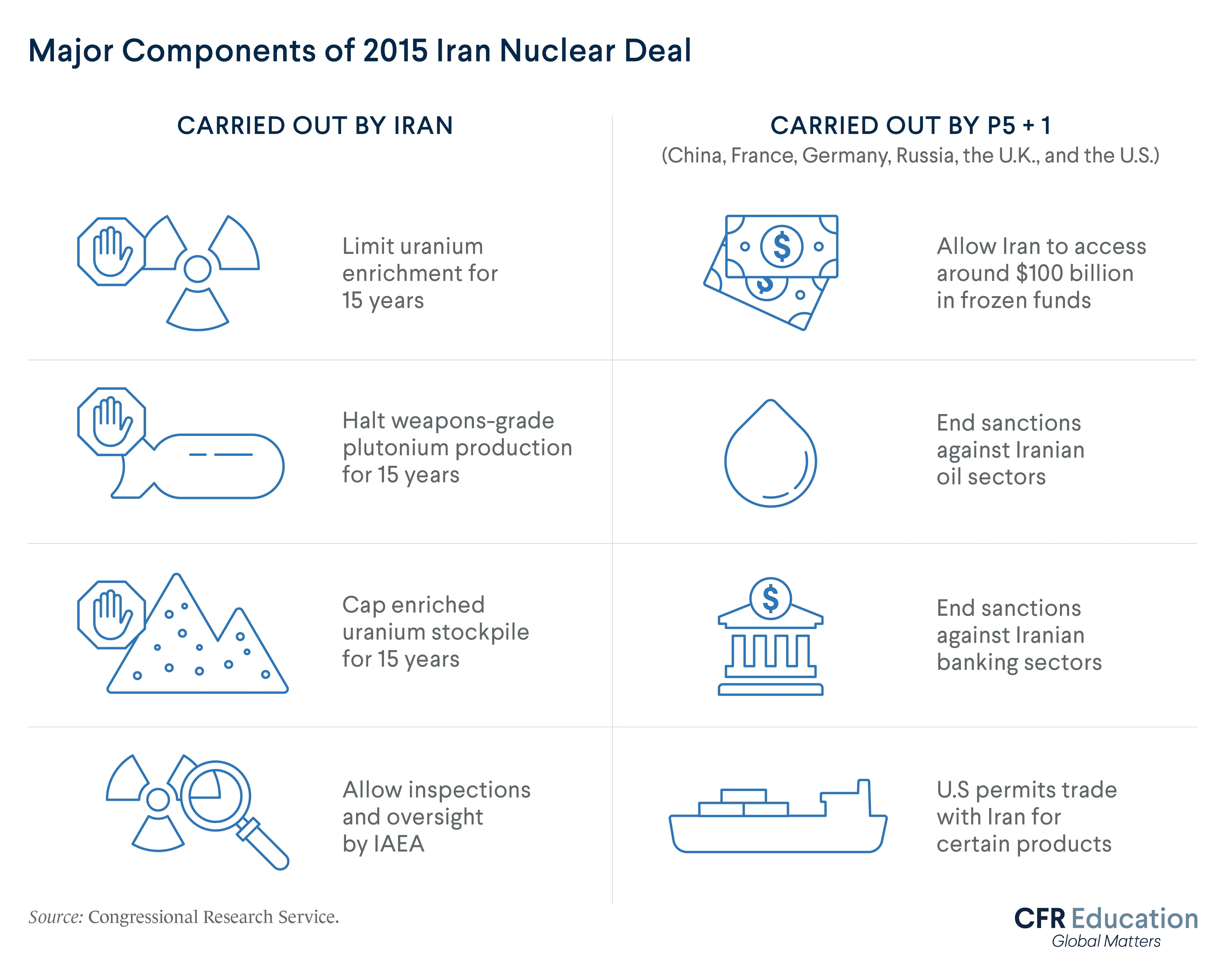
The Biden administration held negotiations to revive the JCPOA, but ultimately failed to make progress, partly due to the shift in foreign policy focus to the war in Ukraine. All the while, there were signs that Iran was continuing to develop its uranium-enrichment capabilities. When President Trump returned to office in 2025, talks resumed only to be followed two months later by a U.S. military strike on a major nuclear site in Iran.
Nuclear negotiations resumed in early February in Oman but appeared to stall several weeks later. While the status of Iran’s uranium enrichment capabilities and weapons program remains unclear, one of several stated goals of the assault on February 28th was to eliminate Iran’s nuclear and missile programs.
Tip: Dive into the full history of nuclear weapons and the efforts to stop them with this timeline.
Foreign Policy Fundamentals
Use the current conflict as an opportunity to teach your students about the fundamentals of foreign policy and the ways in which the U.S. government is structured.
This short video explores three fundamental questions that shape a country’s relationship with the world through foreign policy:
- How extensively should countries involve themselves in foreign engagements (Engagement vs. Isolationism)
- Which principles should drive foreign policy (Idealism vs. Realism)
- What approach should governments take to achieve a country’s foreign policy goals (Unilateralism vs. Multilateralism)
After watching the video, ask your students to identify which approach they believe the United States took on February 28 with Iran.
Just as there are various ways to approach foreign policy, there are numerous tools policymakers can use to implement those approaches. In this specific instance, the United States chose armed force. This reading examines the objectives of using armed force, the different forms it can take, and why officials often resort to it only when all other options have failed to influence a situation.
Who gets to determine when armed force can be used in foreign policy? The Constitution assigns certain enumerated powers to both the executive and legislative branches. But there has been ongoing debate about where presidential power ends and Congressional authority begins, especially as presidents have increasingly used military force without formal declarations of war. Congress has passed legislation aimed at limiting the president's ability to deploy troops without its approval, such as the War Powers Resolution of 1973. However, friction between the two branches has persisted over how to apply those limits in practice. This reading explains how the Constitution currently splits foreign policymaking responsibilities between the executive and legislative branches.
What Happens Next?
What happens next in Iran is uncertain, but possessing a basic understanding of U.S.-Iran relations, foreign policy, and history will help your students evaluate the outcomes, regardless of what they are.
Teach today's most pressing issues.
Frequency
Weekly