How China Transformed Under Mao Zedong and Deng Xiaoping
Explore how Mao Zedong’s Great Leap Forward and Cultural Revolution reshaped China, and how Deng Xiaoping’s reforms set the stage for the nation’s modern rise.

When Mao Zedong and his party took power, China was in a precarious state. A century’s worth of invasions, rebellions, and revolutions had left the country poor, weakened, and humiliated. But Mao had declared an end to China’s shame. “Ours will no longer be a nation subject to insult and humiliation,” he said. “We have stood up.”
Mao aimed to transform his country into a socialist society through nationwide revolution. But in the coming decades, he would launch a series of experiments and political campaigns that would result in some of the darkest periods of China’s modern history.
The Great Leap Forward
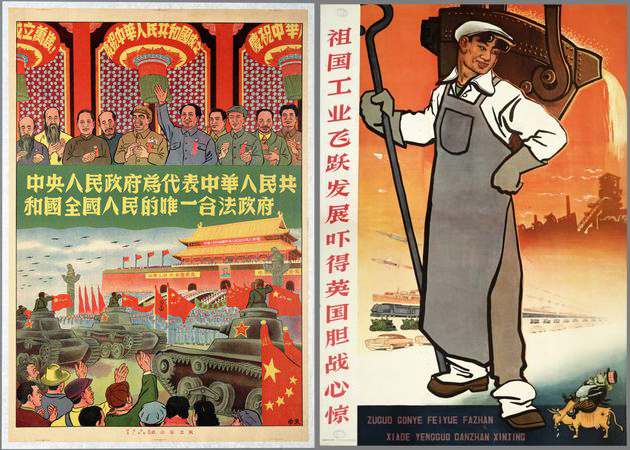
Once responsible for nearly one-third of global production in 1820, China accounted for just 5 percent in 1952. Mao, however, believed that with China’s massive population, he could transform the country. He sought to industrialize society almost overnight.”
Mao’s plan, which he named the Great Leap Forward, began in 1958. This economic initiative called for the countryside to produce enough food to fuel industrial growth in the cities and to send abroad for profit. To this end, the Chinese Communist Party (CCP) organized rural farmers into communes, placed their land under state ownership, and set them to the task of producing grain. Mao also set a goal to double Chinese steel production in just one year. Pressured by CCP officials to meet these targets, ordinary people set up blast furnaces in their backyards to make steel. In response to governmental pressure, Chinese citizens were melting everything from cooking woks to doorknobs.
The results of those initiatives were catastrophic. Backyard furnaces produced unusable steel, and the CCP’s agricultural policies created the worst man-made famine in human history. An estimated forty-five million people perished from starvation and extraordinary violence.
These failures caused Mao’s star to fall in the party, although not for long.
The Cultural Revolution
After the miserable failures of the Great Leap Forward, Mao sought not just to reassert his power but to spur China into political upheaval. He believed repeated revolutions were necessary for socialism to succeed.
Under his guidance, the CCP launched the new Cultural Revolution on May 16, 1966. Mao would achieve his goal of stirring up revolutionary fervor. However, the Cultural Revolution would result in the near dismantlement of the Communist Party from within.
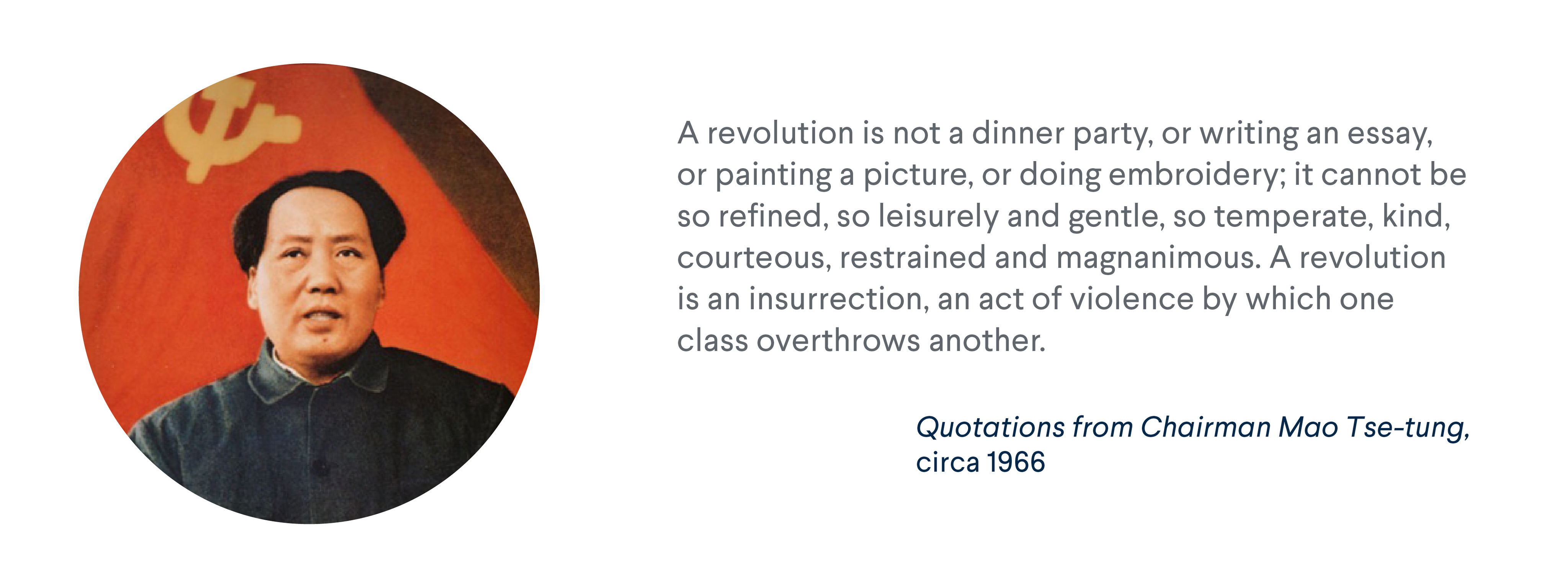
Mao’s new movement called for the proletariat (the workers and peasants of China) to root out and “sweep away all monsters.” This category of enemies included the bourgeoisie (the middle class, academics, and capitalists) as well as anyone perceived as standing in the way of the party and its goals. The movement also urged the creation of a new Chinese identity premised on the destruction of traditional Chinese ways of life. The Four Olds—old culture, old ideas, old customs, and old habits—had to go.
Mao wanted China’s youth to experience revolution so they would carry on the country’s socialist transformation with him at the helm. Millions rose to his challenge. They formed paramilitary groups known as the Red Guards, which wreaked havoc on society. Precious cultural artifacts and religious monuments were ransacked and destroyed. The Red Guards and others targeted teachers, intellectuals, and landlords; anybody they saw as going counter to the revolution was beaten, tortured, and killed. Others were forced to confess to alleged crimes in humiliating public displays.
Meanwhile, the Communist Party was imploding. When Mao launched the Cultural Revolution, he alleged that the party had been infiltrated by counterrevolutionaries and the bourgeoisie. Local operatives responded by overthrowing their superiors.
In 1968, Mao recognized the need to retake control, and the military cracked down. Millions of youths were sent down to the countryside. This was nominally for them to learn from China’s peasant class, but it proved a convenient way to defuse the Red Guards’ power.
The Cultural Revolution only ended in 1976 with Mao’s death. By that point, an estimated three million people had died. Families were torn apart as children denounced their parents for crimes against the CCP. In 1981, the party admitted that the movement caused “the most severe setback and heaviest losses” for the CCP, China, and its people since 1949.
Reforms under Deng Xiaoping
Mao Zedong’s leadership resulted in tens of millions of deaths and some of the most brutal violence in modern history. To some Chinese citizens, however, Mao’s unification of the country and his success in restoring its sovereignty stand out as crucial accomplishments. Still, after enduring the catastrophic consequences of Mao’s policies, the country turned toward reform.
Ordinary people across China—reeling from the turbulence of the Cultural Revolution—had begun splitting up collective farmland and taking part in limited private entrepreneurship. Deng Xiaoping, who succeeded Mao’s chosen successor Hua Guofeng in 1978, embraced those moves. Deng instituted further economic reforms that began to integrate China into the global economy. He introduced a period of “reform and opening up,” and eventually, growth skyrocketed. This four-decade trend has helped more than eight hundred million people escape poverty.
Deng would later become known as the architect of modern China. Among his most influential initiatives was the establishment of special economic zones—regions where, unlike during the Mao era, both foreign investment and limited experiments with market forces were encouraged.
Under Deng, limited political reforms also took place. He fostered greater political stability by addressing past CCP mistakes. Deng also undercut the cult of personality that surrounded Mao, famously admitting that Mao was “70 percent right and 30 percent wrong.” When it came to foreign policy, Deng prioritized maintaining external stability so that China could focus on economic growth. He emphasized that China should eschew international leadership, hide its strength, and bide its time. China pursued a positive relationship with the United States and in general did not press its various territorial claims (with a brief war with Vietnam in 1979 standing as the exception).
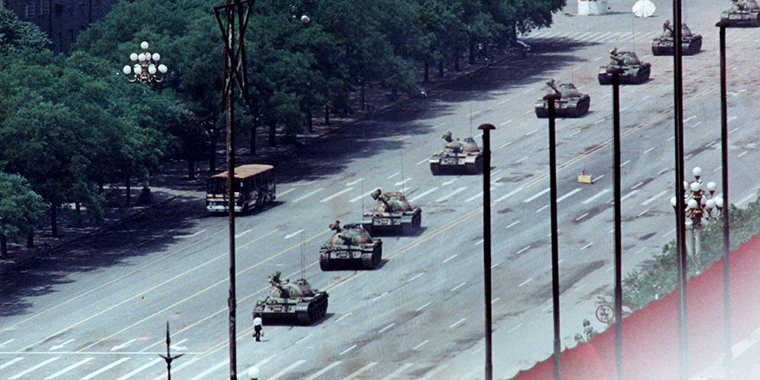
But the reforms had a limit. That limit was revealed in 1989, after a student-led movement urging democratic changes escalated into hunger strikes and mass demonstrations in Beijing’s Tiananmen Square. Hundreds, if not thousands, of people were killed in the ensuing CCP crackdown ordered by Deng. The message was clear: challenges to the CCP’s rule would not be tolerated.
Learn More


